




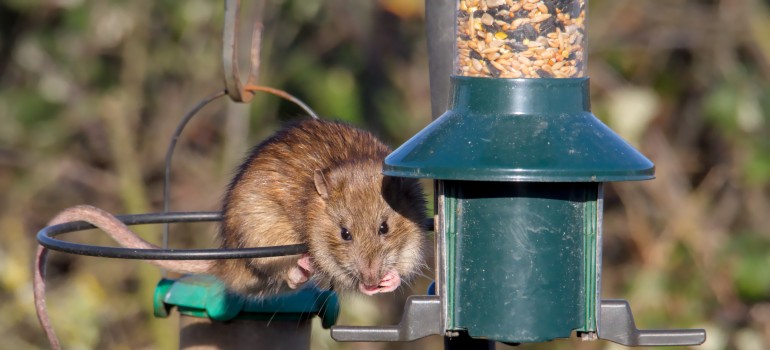
Bird feeding is more popular than ever across the UK, but it comes with an unwelcome side effect: rats. If you’re trying to work out how to feed birds without attracting rats, you’re not alone. The seeds and scraps that robins and sparrows love are just as appealing to rodents looking for an easy meal.
So, how does one protect their property from hungry intruders?
Let’s find out. In this article, we will talk about the ins and outs of keeping your property rat-free and enjoying your bird-feeding hobby at the same time.
TL;DR
- Yes, bird feeders reliably attract rats in the UK — they’ll eat virtually any seed you put out.
- Use a weight-activated cage feeder made from solid metal: rats can’t chew through it and can’t trigger it open.
- Fit a rat baffle to the feeding pole so rats can’t climb up to the feeder at all.
- Store all bird seed in a galvanised metal bin with a secure lid — not in plastic bags or wooden boxes.
- Sweep up fallen seed every day, ideally before dusk when rats become most active.
- Empty birdbaths and remove standing water at night to cut off the other thing rats need most.
- If rats have already moved in and built a nest, stopping the feeding alone won’t shift them — call a professional.
Table of Contents
Do bird feeders attract rats?
Yes, bird feeders reliably attract rats in the UK. Rats are opportunistic feeders and will eat virtually any bird seed, including sunflower hearts, peanuts, nyjer seed, and mixed grain. Ground-feeding setups and fallen seed are the biggest risk. That said, having a feeder doesn’t guarantee rats will appear — the risk depends on your local rat population, your setup, and how well you manage spillage.
Those who have dealt with birdseed catchers or other types of feeders know the answer to this question. Rodents are always on the lookout for food, so it’s safe to say that mice and rats will eat almost anything they can get into. With that in mind, rodents carry serious diseases. Rats in particular are associated with leptospirosis (also known as Weil’s disease), a bacterial infection spread through rat urine that can contaminate water and soil in your garden. That’s a real health risk, not just a nuisance.
And while rats are well known for raiding bird feeders, it’s not 100% guaranteed that they’ll move into your garden just because you have one. You may not have any bird feeders and still have a stubborn rat lurking somewhere in your back garden. With that in mind, we have some tricks up our sleeves to help you reduce long-tailed visitors, so continue reading.
Check also: How to Get Rid of Rats in the Garden Without Poison
How to stop rats from eating bird food
Now that we’ve all accepted the hard truth, let’s finally get to the point. Here are the steps you can take to keep rats and mice away from your bird feeders.
Six practical steps to stop rats getting into your bird feeders and keep your garden rat-free while still feeding the birds.
Install a rat-proof bird feeder
Choose a weight-activated cage feeder for the best protection. These close under a rat’s weight but stay open for lighter birds — the RSPB recommends them specifically for this reason. Look for solid metal construction: rats cannot chew through steel the way they can through plastic or wood. Add a seed-catching tray or skirt beneath the feeder to minimise the amount of seed that reaches the ground, since fallen seed is the biggest draw for rats in the first place.
Fit a rat baffle to the feeding pole
A rat baffle for a bird feeder is a cone-shaped barrier, usually made from metal or smooth plastic, that attaches to the feeding pole below the feeder. Rats cannot climb past it. Baffles work equally well against squirrels. If you have a bird table rather than a hanging feeder, position the table away from walls, fences, and overhanging branches so rats can’t bypass the baffle with a running jump. A bird table with a smooth or overhanging roof made from slate or metal also makes it harder for rodents to get a foothold.
Check also: My Neighbour Has Rats! What Can I Do?
Store bird seed in a galvanised metal bin
Rats and mice are relentless scavengers, and loose seed bags are no match for them. Store all bird food in galvanised metal bins with a secure, close-fitting lid. Rodents can chew through wood, rubber, and low-grade plastic with ease, but solid metal makes the job much harder. Keep the bins in a shed rather than bringing them indoors.
Check also: How to Get Rid of Rats in the Attic
Clean up fallen seed daily
Birds are fussy eaters. They flick aside anything they don’t want, and that discarded seed lands on the ground where rats find it fast. Sweep up fallen seed at least once a day, ideally before dusk when rats become most active. Give your deck the same attention — rats under the decking are a very common problem, and a build-up of seed nearby makes it worse.
Remove standing water at night
Rats need water to survive — unlike mice, which can go a month or more without drinking. If your garden offers both food and a water source, you’re twice as attractive to them. Empty birdbaths each evening and fix any dripping taps or leaking pipes. Ponds and pools are harder to deal with, but cutting off the easy sources is still worth doing.
Check also: Who Is Responsible for Rats in Drains?
Call a pest control professional if rats are established
Many people try rat poison first. That’s understandable, but it’s risky — the wrong bait placed in the wrong spot can harm pets, hedgehogs, and birds of prey. If rats are already present, the safest approach is to bring in a rat pest control professional. A technician will inspect the site, use the right methods for your specific situation, and get rid of the rodents without putting your family or garden wildlife at risk.
Supply:
- galvanised metal bin with secure lid, rat baffle
Rodent control service on a top level!
Book a professional rodent control service for your property. The experts are experienced in treating and proofing protperties against mice, rats and even squirrels.
Call usWill rats leave my garden if I stop feeding birds?
If rats have only recently arrived and bird food is the sole reason they’re visiting, removing feeders and clearing up fallen seed for two to four weeks may be enough to make them move on. But if they’ve established a nest, found a burrow nearby, or discovered other food and water sources in your garden, they’re unlikely to leave on their own. Stopping the feeding is a sensible first step, not a guaranteed fix.
The key question is whether the rats are passing through or have settled in. Passing rats leave little trace — you might spot droppings once or twice and then nothing. Established rats are a different story. Look for worn runs through the grass, fresh burrows near walls or under structures, gnaw marks on fences or shed doors, and smear marks along surfaces where rats travel regularly. If you’re seeing any of those signs, the rats have made themselves at home and won’t leave just because the bird feeder has gone.
While you stop feeding, clean up thoroughly. Remove all fallen seed, secure your bin lids, block any obvious gaps under sheds or decking, and cut off water sources at night. This gives passing rats no reason to return and makes life uncomfortable for any that have settled. If you’ve done all of that and you’re still seeing activity after a few weeks, it’s time to call in a professional rather than waiting it out. An established infestation won’t resolve itself.
What NOT to do
The search results for how to keep rats away from bird feeders may be full of unsafe or inhumane ideas. One such popular, albeit dangerous, concept is poisoning the rats yourself. We already gave you insight into why this is a terrible idea and how it has the potential of going way too wrong.
And your pets are not the only ones in danger. You could also hurt any wild or stray animal that consumes the poison directly or eats the carcass of a poisoned rat.
Another “piece of advice” that you can find is placing glue traps. Glue traps are now illegal in England and Wales under the Glue Traps (Offences) Act 2022, and rightly so. They are indiscriminate and cause prolonged suffering, and other animals including hedgehogs and garden birds can easily get stuck in them too. Don’t use them.
What bird food does not attract rats?
No bird seed is completely rat-proof, but some are less attractive to rats than others. Nyjer (thistle) seed is less palatable to rats than peanuts or sunflower hearts. Dried mealworms offered in small quantities and whole peanuts in wire feeders are also harder for rats to extract and eat. The worst option by far is loose mixed seed scattered on the ground — this is the most rat-friendly setup you can create. Keeping food off the ground and in a well-designed feeder makes a bigger difference than seed choice alone.
Check also:
Humane Methods for Handling Common Household Pests
Do Pigeons Really Carry Diseases?
Takeaways
- Bird feeders attract various animals, including mice, rats, and squirrels — this is the norm in the UK, not the exception.
- A weight-activated cage feeder made from solid metal is the most effective rat-proof bird feeder you can buy.
- Fit a rat baffle to your feeding pole and position bird tables away from walls and overhanging branches to cut off climbing routes.
- Store bird food in galvanised metal containers so rodents can’t chew through to the seeds.
- Mice can last a month without water, but rats can’t — removing standing water at night is one of the simplest deterrents you have.
- If rats have only just arrived, stopping feeding for a few weeks may shift them. If they’re established, professional pest control is the right call — not a last resort.
***
Do you currently have bird feeders in your garden? Share your way of feeding birds without attracting rats in the comments below.


I found that applying a layer of cayenne pepper covered with a layer of sprayed-on cooking oil helps keep all three furry friends away, rats, mice and squirrels. The birds don’t have saliva in their mouth so the hot sauce doesn’t bother them at all.
Rats are not “nasty”. You may not want them in your garden, but they are amazing kittle creatures who are just trying to survive like everyone else.
I agree! I wouldn’t want them in the house but they are just trying to live like all living creatures…..including humans.
I totally agree with you .
One rat , I could live with in the garden but not loads of them .
Rats are living creatures. I am suffering negative consequences of not getting right place for feeders. It didn’t occure to me that rats are such good climbers. Unfortunately they are destroying some of my flower gardens that with feeding birds is what brings me joy and this brings on deppression without it.
I have no problem with batchelor rats. It’s when they go courting that the problem erupts. Unfortunately they breed like rats.
I will try Marilyn Eccles suggestion of cayenne pepper with sprayed on cooking oil to see if that deters our long tailed friends.
Malvin brown