


Get the GoFantastic app


Squirrel Nest – What You Should Know
In the UK, we are accustomed to seeing squirrels pretty much everywhere. They are in parks, in gardens, in rural areas, and in your backyard or lawn. Kids and guests in your home are entertained by them and their cuteness.
Many people in England make squirrel feeders, so that the animals have food easily available. But have you ever wondered where squirrels actually live? Do squirrels actually build their own nests? Let’s explore where and how these fascinating creatures create their homes.
Where do squirrels live
Squirrels can be found in a range of habitats, depending on the species. In the UK, most squirrels call trees their home. You’ll typically spot them in forests, woodlands, parks, and even gardens, especially if there are lots of trees or open spaces with food sources like nuts, seeds, and berries.
Squirrels are highly adaptable creatures. Grey squirrels, for example, are often seen in urban areas, where they thrive in parks and green spaces. Red squirrels, however, tend to prefer the peace and quiet of more remote forests and are less commonly spotted. In cities, squirrels have even been known to make their homes in roof spaces or attics, if they can find a way in.
So, whether it’s a peaceful woodland or a busy city park, squirrels have a knack for finding the perfect place to live!
Read more about squirrels in the UK.
What is a squirrel nest called?
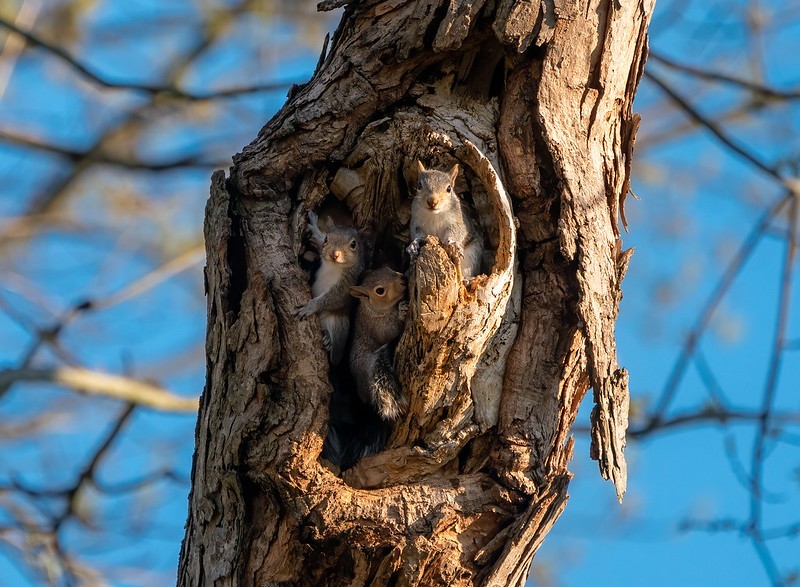
A squirrel’s nest is commonly called a drey. In the UK, both grey squirrels (Sciurus carolinensis) and red squirrels (Sciurus vulgaris) build nests in trees. They also use suitable tree cavities, which provide a sheltered alternative to an exposed nest among the branches. Grey squirrels are familiar visitors to parks and gardens, while red squirrels survive in more restricted parts of the country.
A nest gives a squirrel somewhere to rest, shelter and raise young. It is therefore useful to distinguish a squirrel passing through your garden from one occupying a nesting site. Seeing squirrels near your home does not, by itself, mean that they have entered the building or established a nest in the roof.
This guide explains how to recognise a possible squirrel nest, where to look for one and how nesting changes through the year. It also covers signs of squirrels in a loft and the precautions to take before disturbing nesting material, repairing an access hole or arranging tree work.
What does a squirrel nest look like?
A squirrel drey often resembles a rounded bundle of leafy twigs lodged in a tree. Many are roughly football-sized, although their appearance varies with the materials used, their condition and the surrounding branches. The outer structure provides support, while softer material inside helps insulate the sheltered space.
Look for a compact mass of twigs rather than assuming that every visible collection of sticks is a squirrel nest. Leaves or needles attached to the nesting material can provide a useful clue. However, a distant view rarely reveals enough detail for certain identification. Bird nests and dense growth within the tree can look similar from ground level.
Use binoculars or a camera zoom to inspect the structure without approaching it. Record its position, overall shape and any animal activity around it. A photograph can help an adviser assess what you have found, but it cannot reliably establish whether young are inside. Avoid climbing towards the nest, moving branches or opening the structure to investigate.
Types of Squirrels Nests
There are three common types of squirrel nests.
- Tree cavities– This may be the only squirrel home you can think of. You may have also seen them getting in and out of tree hollows. That’s because cavities in trees make perfect homes for these animals in the winter. They provide better shelter against harsh weather conditions. Squirrels may also use the holes made by woodpeckers.
- Dreys – As we said already, dreys are the nests that squirrels build on their own. Usually, they construct their nests at least six metres above the ground. They use tree branches for stability. Oftentimes, their nests can be confused with those of birds but squirrels’ ones are larger. To build their nests, squirrels use a combination of various rigid and soft materials so they can mould and shape them into a sturdy home.
- Ground burrow – There are some squirrel species that dig burrows for nesting, such as Ground squirrels. They do so in loose soil, such can be found in pastures and fields. Also, they may live in parks and golf courses where they also make tunnels and nests underground. However, this type of squirrel isn’t native to the UK.
Where do squirrels build their nests?
Squirrels build dreys among tree branches and also occupy holes within trunks or large limbs. A branch fork offers support for an external nest, while a tree cavity provides an enclosed nesting space. Suitable trees may be found in woodland, parks and established gardens, so a squirrel nest is not restricted to remote or heavily wooded places.
Nesting opportunities depend on the surrounding habitat. Mature trees can provide both branches for nest building and cavities for shelter. Nearby food sources and connections between trees also influence how squirrels use an area. Red squirrels can occupy coniferous, broadleaved and mixed woodland; describing them simply as animals of quiet, remote forests overlooks this variety.
One squirrel may use several nests within its home range. Finding a second drey nearby does not necessarily mean that two separate families occupy the trees. Equally, a nest that appears quiet during one visit may still be used at another time. Observe the area over time rather than treating a single sighting, or a short absence, as proof of occupancy.
How can you tell a squirrel drey from a bird’s nest?
A rounded structure containing leafy twigs may be a squirrel drey, but appearance alone is not conclusive. Large bird nests can look similar, particularly when partly hidden by branches. Squirrels and birds may also adopt and alter nests previously used by the other, making identification less straightforward than a simple comparison of size or shape.
Watch quietly from a distance for an animal entering or leaving. Seeing a squirrel use the structure provides stronger evidence than judging the sticks alone. Even then, you should not assume that you know whether the nest contains young or whether other wildlife uses nearby cavities.
It is also difficult to distinguish a red squirrel’s drey from a grey squirrel’s drey by appearance. This matters wherever red squirrels occur, because their shelter sites receive legal protection. If tree pruning, felling or building work could affect a suspected nest, arrange an appropriate assessment before work begins. Do not use the nest’s colour, size or untidy appearance as a reason to remove it.
When do squirrels nest and have babies?
Squirrel nesting is not limited to one short season. Nests provide shelter as well as somewhere to breed, and their construction can change with the weather. Summer dreys may be lighter and more open, while autumn brings repair or replacement with better-insulated shelter for winter. Seasonal changes do not provide a dependable timetable for deciding that a nest is empty.
Grey squirrels commonly have two litters in a year, with births typically occurring in February–March and June – July. Timing can vary, so these months should be treated as a guide rather than fixed boundaries. Nest activity and the possibility of dependent young need to be assessed individually.
Young grey squirrels begin exploring outside the nest at about six weeks old. They are generally weaned by around ten weeks and become independent at approximately 10–12 weeks. A small squirrel seen outside may therefore still depend on its mother. First emergence, weaning and independence are different stages; seeing a youngster leave the nest does not mean that removal or exclusion work can safely begin.
Can squirrels build a nest in your loft?
Yes. Squirrels can enter roof spaces and use them for shelter or nesting. An accessible loft provides a protected space. Roof activity deserves investigation because squirrels can also gnaw woodwork and damage the insulation around electrical wiring.
Possible signs include scratching or rustling overhead, droppings, damaged insulation and visible damage around roof-level openings. However, noises and droppings alone do not confirm the species: other animals can occupy roof spaces and leave similar evidence.
Do not assume that a squirrel enters the loft only to search for food and then leaves permanently. Occupancy and the presence of young should be checked before repairs close an access route. Safely check for any accessible exterior damage and avoid direct contact with nesting materials or approaching animals in confined spaces.
What should you do if you find a squirrel nest?
Start by leaving the nest undisturbed while you establish the circumstances. A nest in a garden tree requires a different response from animals occupying a damaged roof. Do not poke, dismantle or move a suspected nest to make its occupants leave, and do not close a building entrance while animals or dependent young may remain inside.
Where red squirrels may be present, seek advice before work affects a nest or shelter site. Red squirrels are protected, and relevant requirements depend on the location and proposed activity. Grey squirrels remain subject to animal welfare requirements, and releasing them into the wild is prohibited. Trapping and relocation should therefore not be presented as a simple household solution.
If a baby squirrel is found on the ground, keep pets away and obtain species-appropriate advice promptly. Do not assume it has been abandoned or take it elsewhere: its mother may be able to retrieve it. For suspected loft nesting, contact a professional squirrel control service to arrange an assessment of activity, access points and suitable next steps.
Squirrels in Your Loft?
Learn more about squirrel behaviour: