




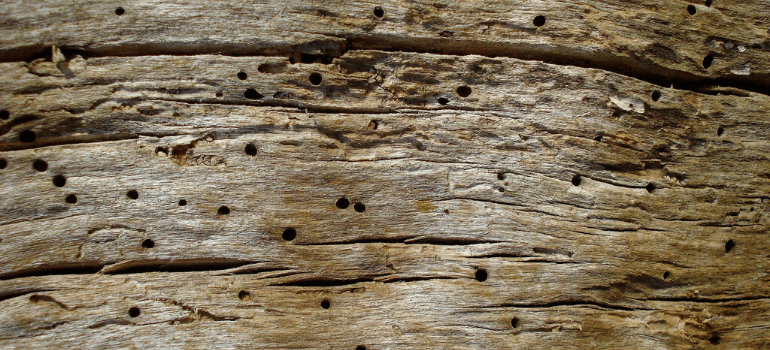
Image by: allispossible.org.uk / License: BY 2.0
Knowing how to treat woodworm in furniture could save you from losing pieces you actually care about. Woodworm is one of the most destructive household pests in the UK — and unlike most infestations, the damage is already done by the time you spot it. The larvae burrow silently through wood for months before you see a single hole.
That’s why acting quickly matters. Whether you’ve just spotted a cluster of tiny holes or you’ve been watching the problem grow, this guide covers how to identify an active infestation, how to treat it yourself, and when it’s time to call in a professional.
TL;DR
- Woodworm is the larval stage of wood-boring beetles, most commonly the Common Furniture Beetle (Anobium punctatum) in UK homes.
- Active infestations leave fresh frass (fine, gritty dust) around small round exit holes — old infestations leave clean, empty holes with no powder.
- The most effective DIY treatment is a permethrin-based woodworm fluid applied directly to bare, sanded wood.
- WD-40 and vinegar do not work — neither penetrates deep enough into the wood to reach the larvae.
- Reduce humidity in affected rooms to make your furniture less attractive to re-infestation.
- If the structural core of a piece feels soft or crumbles, the damage is likely too extensive to save — consider disposal.
- For widespread or repeat infestations, a professional treatment is faster and more reliable than any DIY method.
Table of Contents
What is a woodworm?
Woodworm is a collective term given to the wood-boring larvae of several species of beetles, the most famous of which is the Deathwatch beetle.
The most common woodworm found in UK furniture is the Common Furniture Beetle (Anobium punctatum). It primarily targets softwoods and causes small, round exit holes in the wood.
What does a woodworm beetle look like?
A woodworm beetle is a small insect, usually brown or black, with a cylindrical body roughly 2–5mm long. The Common Furniture Beetle — the one you’re most likely to encounter in the UK — has a slightly humped thorax, a dusty or slightly pitted texture to its wing cases, and antennae that give it a distinctive segmented look. Adults emerge between May and September, which is when you’re most likely to spot them near affected furniture. The larvae themselves are creamy-white, curved grubs that can live inside the wood for two to five years before emerging as adults.
Check also: Most Common Wood Boring Insects in the UK
What causes woodworm to appear?
As with almost all insect larvae, these “worms” thrive in warm, humid conditions and prefer the hospitality that rotten timber offers.
Damp environments, caused by leaks or bad insulation, can quickly cause the wood to decay, and it won’t be long before woodworms settle in.
Fungal problems, such as mould and mildew, only make matters worse as they weaken the structure of the wood and make it easier for the woodworm larvae to burrow deeper.
Another common reason for the infestations is keeping infested wooden material on your property. This includes not only driftwood and firewood but also untreated furniture items, chattels, and even structural elements.
Signs of woodworm in furniture
Spotting woodworm early is the difference between a straightforward treatment and a piece of furniture that’s beyond saving. Here’s what to look for:
- Small round exit holes. Typically 1–2mm in diameter for the Common Furniture Beetle. These are where adult beetles have emerged — not entry points.
- Frass around or beneath the holes. Fresh frass looks like fine, gritty powder — similar to sawdust but slightly more granular. If you see it, the infestation is likely still active. Old, clean holes with no powder are a sign the woodworm may have already left.
- Darkening or staining of the wood surface around the affected area.
- A crumbling or weakened structure when you press on the wood — a sign the tunnelling has reached the core.
- Adult beetles nearby, particularly between May and September. Finding a dead beetle near a piece of furniture is a strong indicator.
Want to know more about their larvae? Check our in-depth entry on woodworms at our Pest Library!
How to tell if woodworm is active or old
Active woodworm leaves fresh frass — a fine, cream-coloured powder around or below the exit holes. Press a piece of white paper beneath the furniture and leave it overnight. If powder falls onto it, the infestation is still going. Old infestations leave clean, dark holes with no powder and no live beetles nearby. That said, don’t assume you’re safe just because the holes look old. The same beetles that emerged will return to lay eggs in the same wood, starting the cycle again.
What is the difference between woodworm and termites?
Termites and woodworms both eat wood and are equally devastating, but making a difference between the two is the first step towards coming up with the appropriate solution.
The first difference stems from the fact that woodworm is the larvae of specific types of beetles, while termites are very social cockroaches that live in colonies.
Unlike woodworms, termites do not bore visible holes in wooden furniture, which is why it’s harder to detect them until there are more obvious signs.
Check also:
How to Get Rid of a Moth Infestation
How to Get Rid of Ants in the House
How to treat woodworm in furniture
The most effective way to treat woodworm in furniture yourself is to apply a permethrin-based woodworm treatment fluid directly to the bare, sanded surface of the affected wood, allowing it to penetrate the exit holes and kill any remaining larvae. For most household furniture, this is a straightforward job — as long as the structural integrity of the piece is still sound. Here’s how to do it properly.
- Step 1. Assess the damage. First, confirm you’re dealing with woodworm. Look for the tell-tale exit holes and check for fresh frass. If the wood feels spongy or crumbles when pressed, the damage may be too extensive to treat — consider disposal.
- Step 2. Decide whether the piece is worth saving. Most of the time, woodworm attacks the upper layers of the wood, leaving the core intact. If the damage is confined to the surface, treatment is straightforward. If the structure feels genuinely weak, it’s better to cut your losses and throw it away.
- Step 3. Buy a permethrin-based woodworm treatment fluid. These products are widely available in DIY and hardware stores. Some need diluting, some are ready to use — read the label before you start. Some are formulated for specific beetle species, so check the packaging if you know what you’re dealing with. If you’re unsure, a professional inspection will give you a clear answer.
- Step 4. Put on protective gear. You’ll be working with a toxic chemical. Wear gloves, safety goggles, and a mask rated for chemical vapours. Work in a well-ventilated space or outdoors if possible.
- Step 5. Sand away any finish or paint. The treatment needs to penetrate the wood directly. Use sandpaper to remove varnish, wax, paint, or any other surface coating from the affected area before applying the product.
- Step 6. Apply the treatment generously. Spray or brush the solution over the damaged area, making sure it gets into the exit holes. Allow to dry fully, then recoat the surface as directed. Two coats are usually recommended for a thorough result.
Are you dealing with a pest infestation?
You don't have to be alone in the battle against pests. Hire a professional pest expert!
Call usHome remedies to eradicate woodworm
If you’d prefer a more natural approach, the following home remedies can help — though it’s worth being honest: none of them are as reliable as a proper chemical treatment. Use them as a complement, not a replacement.
Fresh Acorns
Since the scent of fresh acorns is quite attractive to these insects, you can take a few and wrap them in a cloth. When the breeding season begins, adults lay their eggs on the cloth, and their larvae eat the acorns as they grow.
After the warm months of the year (the time during which the woodworm reproduces) are over, the cloth and its unpleasant occupants can be disposed of.
Even though it is quite a slow method, it is effective as a complement to other treatments, and it can even be used as prevention.
Plastic Cover
Another trick that works well to remove woodworm is to cover the furniture or affected pieces with plastic, leaving a small hole through which a little insecticide can be sprayed. Despite its simplicity, this technique is extremely effective.
How to protect furniture from woodworm
Choosing a conventional pest control product is recommended for anyone who decides to deal with this problem on their own. Sure, they are costly, but they are your best chance of treating the infestation.
But if you prefer to make your own solution, then here is a natural woodworm control method you can try.
DIY woodworm treatment
The first thing to do is bring down the humidity in the room. Woodworm beetles are drawn to damp wood — a dehumidifier or better ventilation makes your furniture a much less appealing target. It won’t cure an active infestation, but it’s a sensible step alongside any treatment.
Next, you can melt beeswax, tint it to match the colour of the wood, and use it to fill the holes. Woodworm reportedly dislikes beeswax, and the method does seal off exit holes neatly. It won’t kill anything still inside, though — so treat it as a finishing step, not the main event.
How to fill woodworm holes
Once you’ve treated the infestation and you’re confident it’s no longer active, you can fill the holes to restore the appearance of the piece. The simplest method is wood putty — available from any DIY store in a range of wood-matching shades. Press it into the holes with a filling knife, wipe away the excess with a damp cloth, and leave it to dry. Sand lightly once set.
Alternatively, mix fine sawdust with a small amount of wood glue to make your own paste. Push it into the holes, wipe clean immediately, and allow to dry fully before sanding. Match the colour with a wood stain or wax finish if needed.
And, even if the woodworm is successfully eradicated, it would be a good idea to treat the rest of your wooden furniture with the same solution. The beetle might have simply left through the window, so pre-treat your remaining possessions just to be sure it doesn’t find itself a new nest.
Keep in mind that woodworm treatment specialists know how to deal with woodworm infestations a lot faster and easier.
Read also: How Pests Decrease the Value of Your Home
Frequently asked questions about woodworm in furniture
What attracts woodworm to furniture?
Woodworms are attracted to damp or untreated wood, especially in older or antique furniture. High humidity levels and softwood are particularly appealing to them.
Can woodworm in furniture spread?
Yes, woodworm can spread to other wooden items in your home. The larvae can burrow into the wood and can move to nearby pieces, leading to a larger infestation. So it is best to take action immediately when you notice signs of woodworm.
Is treating woodworm with WD-40 possible?
No — WD-40 does not work as a woodworm treatment. It doesn’t penetrate far enough into the wood to reach the larvae, which are the real problem. It might coat the surface and kill an adult beetle on contact, but it won’t touch anything living inside the wood. For a proper result, you need a dedicated permethrin-based woodworm fluid that’s designed to penetrate timber and kill at depth.
Is treating woodworm with vinegar possible?
Actually, vinegar is not an effective treatment for woodworm, contrary to what some might say. While it might kill some adult beetles on the surface, it won’t reach the larvae inside the wood.
Can you sell furniture with woodworm?
Selling something without declaring a known defect could expose you to a claim under consumer protection law. Most dealers and auction houses will either refuse the piece or heavily discount it. Your best option is to treat the infestation first, confirm it is no longer active, and then sell — ideally with documentation of the treatment carried out.
How do you know if woodworm damage is old or new?
Fresh woodworm activity leaves powdery frass — a fine, gritty dust — around or below the exit holes. Place a sheet of white paper under the furniture overnight and check it the next morning. Powder on the paper means the infestation is still active. Old damage shows clean, dark holes with no surrounding powder and no adult beetles nearby between May and September. Even so, do not assume old holes mean the problem is gone — adult beetles return to lay eggs in the same timber, restarting the cycle.
Header image source: Levente Nuber/shutterstock.com



Really informative post! I got all the useful information in this blog.
I have been reading about bed bug re emergence for about ten years, I have been using DE around the house for years as a preventative measure, if I do happen to bring some home they dont stand a chance. I also place the sticky traps arond the bed and hang sections of clear contact paper around, I find the occasional gnat, mite or springtail but so far no bedbugs.
Hi my name is Edna l have small holes in bedroom furniture worried to death in case it’s wood worm