




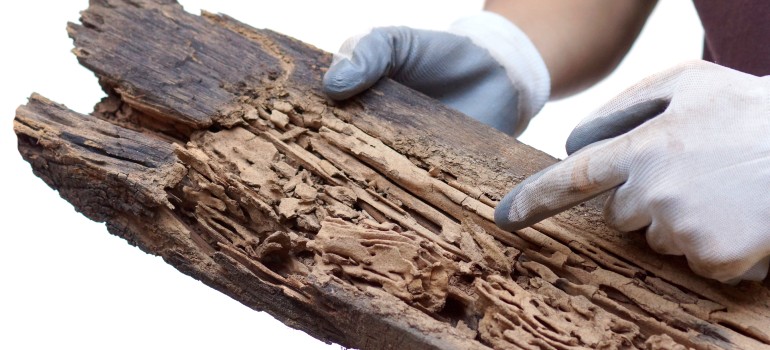
Wood-boring beetles are common to see, particularly in older buildings. While their presence can cause concern, nearly all wood-destroying beetles that inhabit the UK can be treated.
If you are considering any treatment, you need to determine whether the infestation is active or historic. To justify any treatment, a qualified professional must inspect all timber to determine whether there are signs of current activity. There is a possibility that the insect has already died. Therefore, treatment will not be required in this situation.
In the following article, we cover a few common wood-boring insects, the signs of their activity, how to identify them, and how to eradicate them.
TL;DR – Wood Boring Beetles in UK
The most common wood-boring insects found in UK buildings include the common furniture beetle, deathwatch beetle, wood-boring weevil, house longhorn beetle and powderpost beetle. The common furniture beetle is the species most frequently associated with woodworm in British homes. Not every old exit hole means an infestation is still active, so identification and evidence of current activity should come before treatment.
Table of Contents
Common Furniture Beetle (Anobium punctatum)
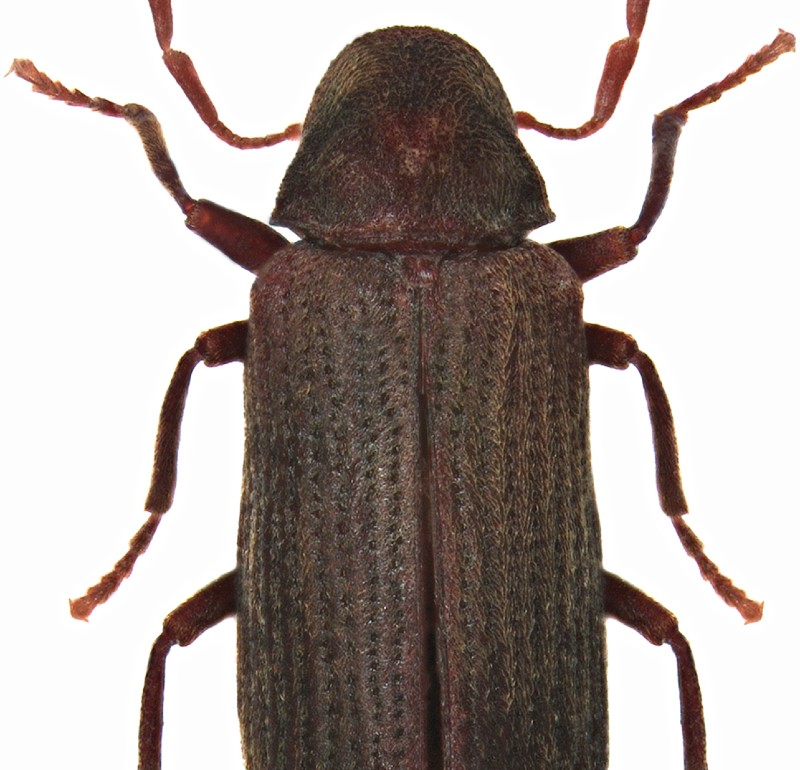
Anobium punctatum is the most common wood-destroying insect found in UK buildings. It prefers dead branches and fallen trees.
An adult beetle is 2.5- 5 mm long and reddish to black-brown in colour. Short yellow hairs cover the surface of the upper body. In addition, there are clearly defined rows of small pits or punctures on the wings.
At its larval stage, the insect bores into the wood and feeds on it. For two to four years, larvae burrow slowly and silently under the surface of a piece of timber. Most of the damage to the wood occurs in this phase.
A common furniture beetle infestation may be identified by tiny, 1.5- 2 mm wide holes surrounded by a fine, dust-like substance called frass. Frass is produced by the larvae eating the wood’s interior. The adults chew through the wood’s surface after metamorphosis to emerge from inside the wood and mate.
Taking preventative measures is key. They target seasoned sapwood rather than fresh or live wood. Wood must be treated before it is used since these insects usually stay away from heartwood.
Deathwatch Beetle (Xestobium rufovillosum)
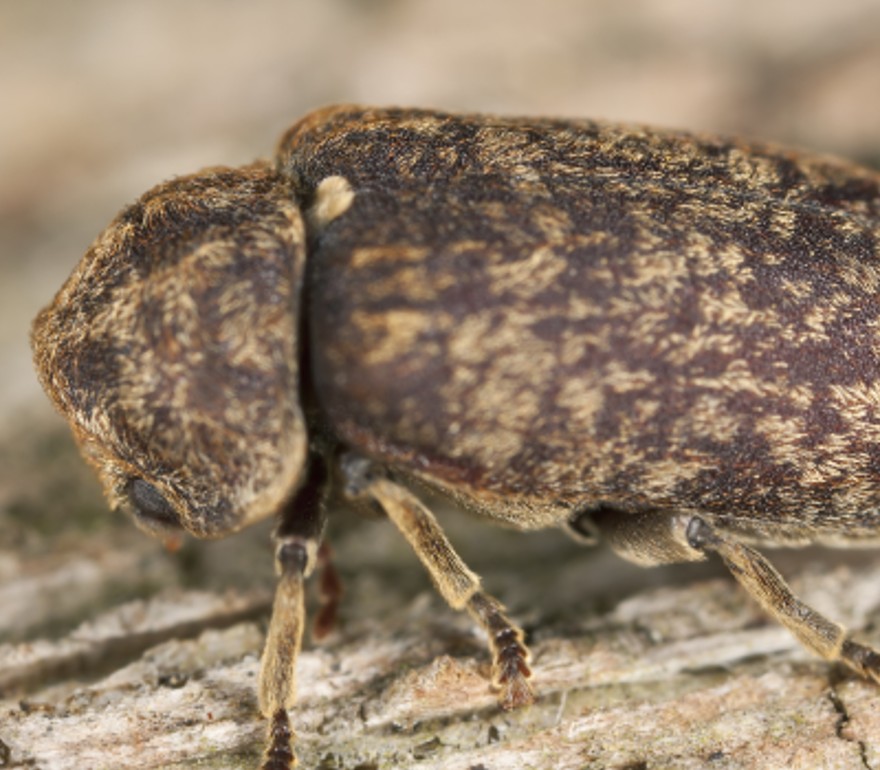
Due to its preference for partially decayed hardwoods, mainly oak, the deathwatch beetle is most frequently found in churches and other historical buildings. These beetles are 5- 8 mm long, dark chocolate brown, and have short yellowish hairs that give them a variegated appearance.
There are often small pellets in the frass produced by the larvae, which differentiate this damage from that caused by other wood-boring insects, along with the noticeably larger (3mm) holes.
The presence of adult deathwatch beetles, which are usually found on nearby floors, indicates an active infestation. If possible, conduct your survey during the flight season, typically between April and June.
A deathwatch beetle infestation can be particularly difficult to treat. During the emergence period of the beetle, spraying an insecticide helps destroy eggs and young larvae before they enter the wood. However, it is doubtful that such treatment will kill older larvae working at significant depths below the surface.
Keep defective or decaying wood out of your house. Freezing can be helpful when it comes to smaller, infested items.
Check also:
What to Do If You See Signs of Pest Infestation
House Longhorn Beetle (Hylotrupes Bajulus)
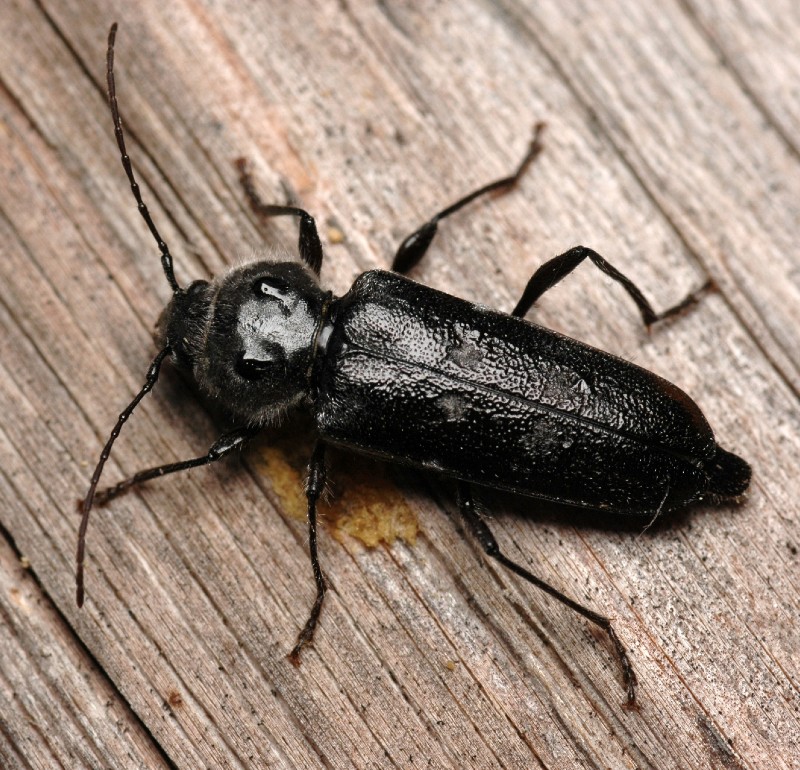
This house longhorn species (Hylotrupes bajulus) is widespread primarily in the southern part of the country, specifically northwest Surrey. An insect that attacks mostly softwoods infects their sapwood, in particular that of roofing timbers in particular.
The adult beetle is 7-25 mm long and typically reddish-brown with greyish/white spots. There are two shiny black spots on the head and body that resemble eyes. The hair on the head and body is grey, and it has long curving antennae.
As they eat their way out of the timber, the mature house longhorn beetles create holes between 6-10 mm in diameter. Compared to the common form of woodworm, the common furniture beetle, house longhorn leaves significantly larger holes.
Permethrin-based woodworm treatment is effective at controlling and preventing house longhorn beetle infestations. This can be used as a surface treatment and injection into emergence holes.
Wood Boring Weevil (Euophryum Confine)
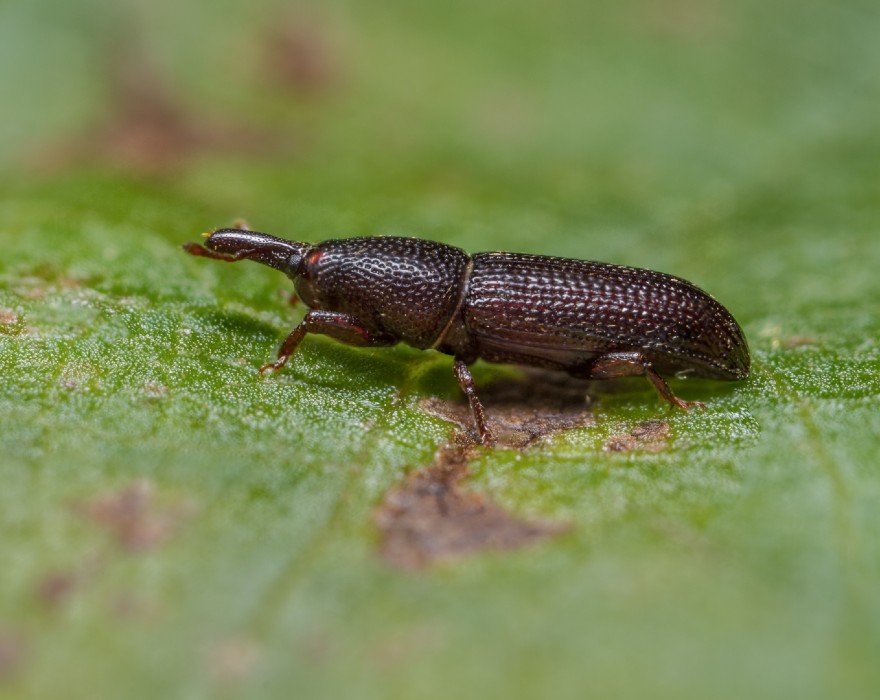
This species is probably the second most common wood-boring beetle seen in buildings across the UK. Reddish-brown to black, adults measure 2.5-5mm in length and have a long flat body with a distinctive long snout.
Their main attack target is decaying and damp softwood and hardwood, often infested with fungus. They can damage plywood as well. The activities of wood-boring weevils are limited to damp and partially rotten wood. The most likely places they can be found are in poorly ventilated areas like cellars and basements. Furthermore, they can be found behind mouldy skirting boards and wall plates when fungal decay is present.
It is easy to recognise wood-boring weevils by their tunnels, which appear normally along the grain, occasionally reaching the wood surface. Emergence holes are small and measure about 1mm in diameter.
In cases where weevil damage occurs, mould decay is the primary concern. Wood-boring weevils are best dealt with by removing the source of moisture and drying out timbers. It is impossible for a wood-boring weevil to infest sound dry wood, so decayed timbers must be replaced. This is probably the most environmentally friendly way to do so, and generally, wood-boring weevils do not require woodworm treatment.
Check also: Stop the Woodworm Infestation in Your Furniture
Powderpost Beetle (Lyctus Brunneus)
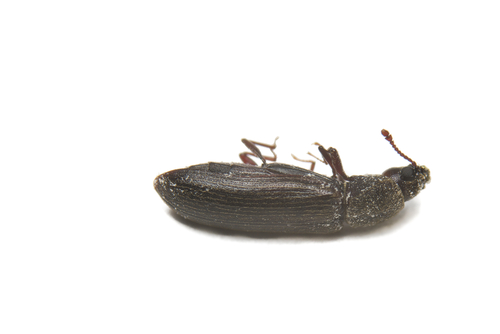
Powderpost beetles are a group of small wood-boring beetles that can damage hardwood timber, particularly materials containing high levels of starch in the sapwood. Although they are less commonly encountered in UK buildings than the common furniture beetle, they can occasionally be found in hardwood furniture, flooring, decorative items and imported timber products.
Adult powderpost beetles are usually small, cylindrical insects ranging from around 1.5–6mm in length, depending on the species. They are generally reddish-brown to dark brown in colour and are rarely seen because most of their development takes place inside the timber.
The presence of powderpost beetles is often identified by numerous small, round exit holes and a very fine, powder-like frass produced by the larvae as they feed within the wood. The frass is usually much finer than that produced by many other wood-boring insects and can resemble flour or dust.
Powderpost beetle larvae can remain inside timber for several years before emerging as adults. The damage is usually associated with hardwood sapwood, where larvae consume the starch-rich content of the timber. Once the available nutrients are reduced, older, seasoned timber is less likely to support continued infestation.
Common Wood-Boring Insects in the UK: Quick Comparison and Identification
| Feature | Common Furniture Beetle | Deathwatch Beetle | House Longhorn Beetle | Wood-Boring Weevil | Powderpost Beetle | |
|---|---|---|---|---|---|---|
| Size | Adult beetles are usually around 2.5–5mm long and reddish to dark brown in colour | Adults are typically 5–8mm long and dark brown with short yellowish hairs giving a mottled appearance | One of the larger wood-boring beetles, with adults measuring around 7–25mm long | Adults are usually 2.5–5mm long with a distinctive long snout and reddish-brown to black body | Small beetles that usually measure around 1.5–6mm long, depending on the species. They are generally reddish-brown to dark brown in colour | |
| Preferred Timber | Mainly attacks seasoned softwood sapwood but can also affect some hardwoods | Prefers older hardwoods, especially oak, often where timber has been affected by decay | Usually attacks softwood, particularly structural timbers such as roof timbers | Only affects damp, decaying timber, often where fungal decay is already present | Mainly attacks hardwood sapwood, particularly timber with a high starch content, including furniture, flooring and decorative wooden items | |
| Exit Hole Size | Small round holes usually around 1.5–2mm in diameter | Larger holes, usually around 3mm in diameter, often with signs of deeper timber damage | Large exit holes typically measuring around 6–10mm in diameter | Small holes usually around 1mm in diameter, often following the grain of the timber | Small round exit holes, usually around 1–2mm in diameter, often accompanied by very fine powder-like frass | |
| Signs of Activity | Small round holes with fine, powder-like frass caused by larvae feeding inside the timber | Larger holes with pellet-like frass and adult beetles appearing around the property during the emergence period | Large emergence holes, extensive internal tunnelling, and weakened structural timber caused by larval feeding | Tunnels along the grain of damp timber, small holes, and evidence of moisture or fungal decay | Multiple small exit holes with fine, flour-like frass produced by larvae feeding inside hardwood timber | |
| Common Locations | Furniture, floorboards, roof timbers, wooden fittings, and other seasoned timber inside buildings | Historic buildings, churches, and older properties containing hardwood structural timbers | Roof spaces and structural softwood timbers, particularly in areas where suitable conditions exist | Basements, cellars, damp wall plates, and areas where timber has been affected by moisture | Hardwood furniture, flooring, joinery, decorative items and imported timber products | |
| Treatment Approach | Requires confirming whether the infestation is active before treatment. Suitable timber treatments may be used where current activity is identified | Usually requires professional assessment due to the depth of larval activity and the condition of affected timber | Professional treatment is recommended due to the potential impact on structural softwood timbers | The main priority is removing the moisture source and replacing severely decayed timber where necessary | Requires confirmation of active infestation before treatment. Suitable timber treatments may be recommended together with measures to prevent reinfestation |
Signs of Wood-Boring Beetles
Wood-boring beetles can remain hidden inside timber for several years, making early detection difficult. In many cases, the first visible signs are not the beetles themselves but the evidence they leave behind. However, finding signs of damage does not always mean there is an active infestation, as old exit holes can remain visible long after the beetles have left the timber.
The most common signs of wood-boring beetles include:
- Small round exit holes – Adult beetles create holes as they emerge from the timber after completing their development. The size of these holes can help identify the likely species, although it should not be used as the only method of identification.
- Fine frass or bore dust – Larvae produce a powder-like waste material called frass as they feed inside the wood. Fresh frass beneath timber or around exit holes can indicate recent activity.
- Tunnels beneath the timber surface – Most damage is caused during the larval stage when insects feed inside the wood. These tunnels can weaken timber, particularly when the infestation is extensive.
- Adult beetles appearing indoors – Finding adult beetles near affected timber, particularly during the emergence season, can indicate that an infestation may still be active.
- Damaged or weakened timber – In severe cases, extensive feeding can affect the strength of wooden structures, including floorboards, joists and roof timbers.
How to get rid of wood-boring insects
Before any treatment is considered, it is important to determine whether the infestation is active or historic. A professional inspection can help identify the insect species, assess the extent of damage and establish whether treatment is necessary.
Wood-boring insects can be difficult to control because the correct treatment depends on several factors, including the insect species, whether the infestation is active, the type and condition of the timber, and the extent of the damage.
The first step is accurate identification. Not every hole in timber indicates an active infestation, and some damage may be historic. A professional inspection can help determine whether beetles are still present and whether treatment is required.
Depending on the species and circumstances, treatment options may include applying suitable residual insecticides, such as permethrin, to accessible timber surfaces, using specialist treatments such as professional fogging where appropriate, or carrying out more extensive measures such as fumigation service in specific situations. In cases where timber has been severely damaged or affected by decay, replacement of the affected wood may be necessary.
Because wood-boring beetles often develop inside timber where they are difficult to reach, it is recommended to seek advice from an experienced woodworm treatment specialist before attempting DIY treatments. A specialist can identify the cause of the damage, recommend the most suitable approach and help prevent further deterioration of the timber.
Are you dealing with a pest infestation?
You don't have to be alone in the battle against pests. Hire a professional pest expert!
Call us


Leave a Reply