



You’ve spotted a bed bug. Maybe a few. The panic sets in, and your eyes land on the bottle of bleach under the sink. It kills germs, strips stains, and smells like it means business. Surely it’ll sort this out too? It’s a thought that crosses a lot of people’s minds when they’re dealing with a bed bug problem, and honestly, it makes sense on the surface.
But there’s a real gap between what bleach can do in theory and what it actually delivers when you’re staring down a full infestation. Before you reach for that bottle, it’s worth understanding what bleach does to bed bugs, what it can’t do, and why leaning on it too heavily can make your situation worse.
TL;DR
- Bleach can kill bed bugs on direct contact, but it won’t reach the ones hiding in walls, furniture joints, or mattress seams.
- It has no residual effect, so it won’t stop new bugs or eggs from developing after you apply it.
- Bleach can damage fabrics, furniture, and flooring, and its fumes pose real health risks in enclosed spaces.
- Safer, proven alternatives include high-temperature washing, steam treatment, and mattress encasements.
- For a full infestation, professional pest control is the most reliable route.
Table of Contents
Does Bleach Kill Bed Bugs?
Bleach can kill bed bugs on direct contact, but it won’t eliminate an infestation. It can’t reach bed bugs hiding in wall cavities, mattress seams, or furniture joints, and it’s largely ineffective against eggs. As a one-off fix, it falls well short of what a real infestation needs.
Here’s the thing about bed bugs: they don’t hang around in the open waiting to be sprayed. They tuck themselves into the tightest, darkest spots they can find. The seam of a mattress. The gap behind a skirting board. The joint of a bed frame. Even if you douse every visible surface with bleach, the vast majority of the population stays completely untouched.
Eggs are an even bigger problem. Bed bug eggs have a protective outer coating, and bleach simply doesn’t penetrate it reliably. Even with direct application, results are inconsistent. In a real home environment, where you’re misting surfaces from a distance, the concentration that actually hits the egg is rarely enough to destroy it. Those eggs hatch, and the cycle starts again.
So yes, if a bed bug walks directly through a pool of bleach, it’s not going to survive. But in practice, that scenario rarely plays out at scale. You’d need to find every single bug, in every single hiding spot, and douse it individually. That’s not pest control. That’s wishful thinking.

Bleach treatments on bed bugs tend to give people a false sense of progress. You’ll kill a handful on the surface and think it’s working, but the infestation underneath carries on untouched. By the time most people call us, they’ve wasted two or three weeks on DIY attempts, and the population has only grown.
What Are the Risks of Using Bleach for Bed Bug Control?
Using bleach on a bed bug infestation isn’t just ineffective. It can actively make your situation worse. There are three main areas of risk: health, materials, and chemical interactions. None of them are trivial.
Health risks from fumes
Bleach releases chlorine gas when used in concentrated form, especially in enclosed spaces like bedrooms with little ventilation. Short-term exposure causes throat irritation, coughing, and watery eyes. Prolonged or heavy exposure in a small room is a more serious matter, particularly for anyone with asthma, respiratory conditions, or young children in the house. Spraying bleach repeatedly in a bedroom where you sleep is not a sensible trade-off, especially when the bugs are still there the next morning.
Material and fabric damage
Bleach doesn’t discriminate. It’ll strip colour from your mattress, eat through fabric fibres, bleach out carpet, and corrode certain metal finishes on bed frames. If you’re applying it to furniture or soft furnishings in an attempt to reach bed bugs, you’re likely causing permanent damage to items that cost considerably more to replace than a professional treatment would have.
Dangerous reactions with other products
This one matters a lot. If you’ve previously used any kind of pesticide spray in the same area and then apply bleach, you’re introducing a chemical mix you have no way of predicting. Bleach reacts badly with ammonia-based cleaners, producing chloramine gas. It reacts with certain organic compounds to create chlorinated byproducts. If there are pesticide residues on surfaces and you spray bleach over the top, the resulting mixture can be more toxic than either substance alone. You’re not improving your pest control. You’re creating a hazardous environment in your own home.
Check also:
What Actually Works Instead?
The good news is there are methods that genuinely work. Some you can do yourself, some are best left to professionals.
High-temperature washing
Strip your bed completely and wash everything at 60°C or higher. Bed bugs and their eggs don’t survive sustained heat at that level. Dry on the highest heat setting too. Bag items before moving them through the house to avoid spreading bugs to other rooms.
Steam treatment
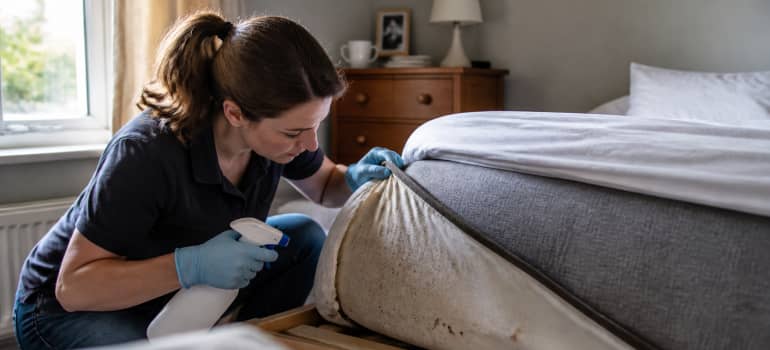
A good steam cleaner reaches temperatures that kill bed bugs and eggs on contact. Work slowly over mattress seams, bed frame joints, and furniture folds. Steam penetrates fabric and crevices far better than any spray, bleach included. Focus on the areas where bed bugs actually hide, not just the visible surfaces.
Mattress encasements
Mattress encasements trap any remaining bugs inside where they eventually die, while preventing new ones from getting in. Use encasements specifically designed to be bed-bug-proof, with fine zip closures. Leave them on for at least a year to be safe. This works equally well on a standard mattress or a divan base.
Reducing clutter
Bed bugs thrive in clutter. Clear out anything unnecessary from the bedroom, particularly near the bed. The fewer places they have to hide, the more effective any treatment becomes. It’s not glamorous advice, but it makes a real difference.
Professional treatment
If the infestation is already established, calling in a professional is the most reliable option. A bed bug control service will carry out a thorough inspection, locate every harbourage site, and apply treatments that work across all life stages of the bug. That includes residual insecticides that stay active for weeks, and heat treatments that reach areas no spray can get to. No household product comes close to that.
Check also:
Frequently Asked Questions
Can you use bleach as a preventative measure against bed bugs?
No. Bleach has no residual effect, so once it dries it stops working entirely. It won’t create a protective barrier or deter bed bugs from moving into an area. If prevention is the goal, focus on inspecting second-hand furniture before bringing it indoors, using mattress encasements, and checking luggage after travel.
What should I do immediately if I find bed bugs?
Isolate the affected area as much as possible. Wash all bedding at 60°C or above and dry on a high heat setting. Avoid moving items between rooms, as this spreads bugs through the property. Inspect the mattress seams, bed frame joints, and nearby furniture carefully. If you find live bugs or shed skins, contact a pest control professional sooner rather than later.
Is it safe to mix bleach with other pest control products?
Absolutely not. Mixing bleach with other chemicals, including many common household cleaners and pesticide sprays, can produce toxic gases. Chloramine gas from bleach and ammonia-based products is particularly dangerous. Never combine bleach with any other substance when attempting pest control. The risk to your health far outweighs any perceived benefit.
How do professional pest controllers treat bed bug infestations?
Professionals typically use a combination of approaches depending on the severity of the infestation. These include residual insecticide treatments applied to known harbourage sites, heat treatments that raise room temperatures to levels lethal to all life stages of bed bugs, and targeted steam application. The key difference is thoroughness and the use of products that remain active long after the initial treatment.
Ready to get rid of bed bugs for good?
Don't let a failed DIY attempt give the infestation more time to grow, get expert help today.
Contact usConclusion
Bleach can kill a bed bug if it lands directly on one. That’s the full extent of its usefulness against an infestation. It doesn’t reach the hidden colonies, it doesn’t work reliably on eggs, it leaves no lasting protection, and it brings a genuine set of health and safety risks into your home. Using it as your main response to a bed bug problem isn’t just ineffective. It’s a delay that lets the situation get worse.
Heat, steam, encasements, and professional treatment all address the problem where it actually lives. If you’re dealing with more than a stray bug or two, don’t waste time on bleach. Reach for something that works, and keep yourself and your household safe in the process.