



Nobody likes bed bugs or enjoys having them around. They invade your space and take sneaky bites while you sleep, leaving you exhausted and anxious at the very least.
Most people’s go-to solution to try to get rid of bed bugs is applying vinegar because it’s natural and affordable. When you stop to think about it, though, does vinegar kill bed bugs, or is it mostly just wishful thinking?
We have the answer for you. Read on to know exactly how effective this popular home remedy is, where it lacks, and what could work even better.
TL;DR
Vinegar can kill bed bugs, but only on direct contact — it has to fully soak the bug, takes several minutes to half an hour, and does nothing to eggs or bugs hiding in cracks, seams, and furniture joints. It offers no lasting protection once dry, can damage some surfaces, and often creates a false sense of progress while the infestation quietly rebuilds.
Table of Contents
Does vinegar actually kill bed bugs?
Yes, vinegar can kill bed bugs when applied directly. The acetic acid starts eating away at their waxy exoskeleton and interrupts their breathing, so they eventually die.
It’s not gentle. It basically suffocates and corrodes them on contact. There’s a catch, though. You have to aim it directly and completely surround the bug.
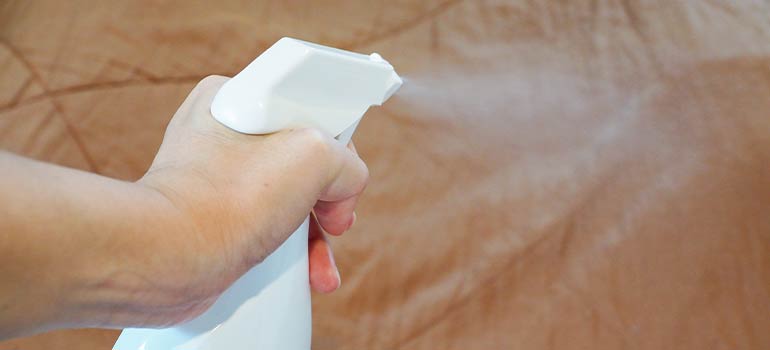
A light mist from across the room will simply not get the job done. The bug will just scuttle along and live another day.
Timing is an aspect too, and it’s fair to wonder how long it takes vinegar to kill bed bugs. Well, it’s not as quick as you would want it to be. Depending on how thoroughly they’re drenched and the concentration of the vinegar, it can take anywhere from several minutes to half an hour.
When it comes to the type of vinegar, most people go for white vinegar because it’s stronger and purer than others. Apple cider vinegar can also be used, but it’s weaker and cloudier. Besides, it will clog up your spray bottles and leave sticky residue everywhere it lands. When using vinegar, remember to dilute it with the same amount of water. It will save your spray nozzle from eventually gunking up.
Another thing to consider is the fact that bed bugs like to hide, and they’re good at it. They’re usually in those narrow cracks along the baseboards, deep in mattress seams, or even tucked behind a picture frame or inside a drawer joint.
Unless you’re tearing the place apart, your spray is probably hitting maybe 10% of them, if you’re lucky.
Check also: Spider Bite or a Bed Bug Bite?
Can vinegar in laundry kill bed bugs?
Vinegar gets thrown into washing machines for various reasons, like to get rid of bad odours or to remove stubborn stains. However, adding vinegar to your laundry to kill bed bugs is not really recommended. The heat is actually what destroys them, not the vinegar.
For an effective eradication of bed bugs, the water temperature needs to hit 60°C minimum. After that, everything goes into the dryer—hottest setting you’ve got—and stays there for a proper cycle.
That combination of sustained high heat at both stages is what actually destroys them. Adults and nymphs die, while eggs get cooked through their shells. Vinegar sitting in the drum with your sheets doesn’t really contribute much.
Vinegar might bother a bug or two if they’re exposed, but it’s not strong enough to rely on, especially not in the thicker areas or anywhere they can wedge themselves in and wait it out. They just hunker down and survive just fine.
Check also: How to Check for Bed Bugs
Can vinegar kill bed bug eggs?
This is the bit that gets people the most.
You’ve been spraying vinegar around. You even killed some adult bed bugs and felt like progress was happening. Maybe the bites even stopped for a while. You’re thinking—finally, sorted. A few days later, they’re back.
It’s the eggs. That’s basically what it comes down to. The acid in vinegar cannot penetrate that exterior, regardless of how many times you spray the same egg.
They’re also usually hidden in seams, tucked into cracks, and stuck to surfaces you’d never think to check. And they’ve got this coating or shell that’s designed to keep what’s inside alive and protected.
The eggs hatch in about a week or so (longer if their environment is cold). Once they do, those baby bugs are hungry immediately. They tend to find you fast. That’s why you could suddenly find yourself dealing with a fresh wave of bites when you thought you dealt with the problem.
Ultimately, there is no easy answer to whether vinegar kills bed bugs and their eggs. There are many home-based approaches, vinegar among them, that do achieve partial success. Yet, they leave the eggs largely unaffected, setting the stage for ongoing reinfestation.
Creepy crawlers invading your home again?
Professional bed bug control eliminates them for good
Call usLimitations and why vinegar often makes bed bug problems worse
It’s tempting to keep trying when you see a dead bug here and there, but vinegar has some serious drawbacks that turn small problems into bigger headaches, as follows:
- No good against hiding spots. Bed bugs wedge into tiny gaps, such as the dead area behind sockets, under carpets, and even inside furniture joints. Your vinegar spray doesn’t reach that far, no matter how hard you try.
- No residual power. Once it dries, it’s gone. It has no lingering protection against new bugs hatching from eggs or the ones that avoided the spray.
- False sense of security. You think, “I’ve treated it,” so you relax. Meanwhile, the population rebuilds. Weeks later, you’re worse off.
- Strong smell. That sharp odour hangs around for days, and on fabrics, it seems to last forever. Combine it with stress and sleepless nights—not fun.
- Surface damage. Some materials don’t react all that well to vinegar, such as wood finishes and certain paints. If you over-apply vinegar, you will start noticing discolouration and certain marks that will be hard to remove.
- Huge effort and no real result. You just end up spraying obsessively, every crack, every night. You will get tired and drained quickly when the result is not worth it.
When it comes down to it, using vinegar will not kill bed bugs for good, so it’s not really the real fix you’re after. It might knock back a bug or two, but it’s more of a temporary nuisance that will leave you more frustrated as time goes by.
Check also: Common Questions About Bed Bugs Infestations
Which is better for bed bugs, alcohol or vinegar?
This question comes up constantly.
Rubbing alcohol works faster for sure. It breaks down the bug’s shell and sucks the moisture out of it. You might not even see it happen. In contrast, vinegar takes its time and burns through it slowly.
That said, speed doesn’t matter when both of them have the exact same problem—they only work on bugs you can actually hit. That’s it.
Alcohol also evaporates almost immediately. Plus, it’s flammable, which is not ideal when you’re spraying it all over your bed, and there’s a plug socket two feet away.
In contrast, that acidic tang from vinegar lingers for a few hours, sometimes days, if you’ve used a lot. It leaves a slight sticky residue on surfaces too, though nothing terrible.
The debate of which is better for bed bugs, alcohol or vinegar, is not really a strong one, since neither will solve the issue once and for all.
Check also: How to Prepare for Bed Bug Heat Treatment
So what kills bed bugs instantly?
This is what everyone wants to know when they’re exhausted and covered in bites at 3 am. Here’s the truth, though—nothing you have at home will wipe out an entire infestation in one go. There are simply too many of them in a lot of different places. You would need to reach all of the bugs, all at once, which just isn’t happening with a spray bottle.
What really kills bed bugs and their eggs is professional pest control. Pest technicians show up with equipment and training you don’t have. They’re not guessing where bugs might be—they know where to look. They inspect all the places bed bugs actually live in when they’re not feeding on you.
The key eco-friendly approach that specialists use—and one that comes closest to that “instant” kill—is heat treatment. Exposing infested items or rooms to sustained high temperatures reliably kills all life stages, including eggs.
This is the most effective way to handle a full infestation. Experts in heat treatment can get things back to normal faster than you might expect. It’s a highly systematic and thorough approach, which is exactly what you need to kill bed bugs instantly.
Home remedies like vinegar simply don’t provide lasting solutions for bed bug problems. These treatments might eliminate a handful of bugs on contact. However, they leave entire colonies untouched in their hiding spots and fail to destroy the eggs. The infestation inevitably rebuilds itself within weeks.
Professional bed bug control takes a different approach. These services target every stage of the bed bug lifecycle and reach the areas where these pests actually live. They bring the problem to a permanent end.
Takeaways
- Vinegar can kill bed bugs on direct contact, but it’s slow and doesn’t solve the issue for good.
- White vinegar outperforms apple cider vinegar, though neither handles eggs or hidden bugs.
- Adding vinegar to your laundry adds little beyond what hot water and dryer heat already do.
- Vinegar doesn’t affect eggs no matter how many applications take place, so reinfestation is guaranteed.
- Alcohol works faster on contact than vinegar, but shares the same big limitations.
- Real elimination usually requires hiring professional pest control services. Heat treatment or expert-applied methods reach all the spots where home remedies can’t.
Check also: