


Get the GoFantastic app


Pigeons in the UK: Species, Behaviour and Key Facts

Five species of pigeons and doves are commonly found in the UK: feral pigeons, woodpigeons, stock doves, collared doves and turtle doves. They all belong to the Columbidae family, which includes more than 300 species worldwide. Although the names are often used differently, there is no scientific distinction between pigeons and doves. Feral pigeons and wild rock doves are also the same species.
The easiest way to identify UK pigeons is by their size, colouring, markings and habitat. Feral pigeons are familiar sights in towns and cities, while woodpigeons are widespread in gardens, parks and countryside. Stock doves are often mistaken for other pigeons, collared doves are recognised by their black neck markings, and the increasingly rare turtle dove visits the UK during summer.
This guide covers UK pigeon species, key facts and identification, habitat, diet and behaviour. It also explains their legal protection in the UK and what property owners should know when pigeons become a nuisance.
Types of pigeons in the UK: identification and population
The five common UK pigeon and dove species differ in size, colouring and markings, making some easier to recognise than others. Woodpigeons are the most numerous, while turtle doves are now exceptionally scarce. The comparison below highlights the distinguishing features of each species alongside their estimated UK breeding populations.
| Species | How to identify them | UK breeding population |
|---|---|---|
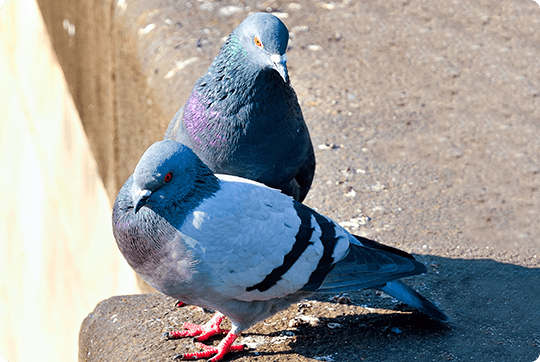
| Feral pigeon / rock dove | Variable colours, from grey with darker chequering to brick-red, cinnamon-brown or white. Wild rock doves have bold black wing bars and a pale rump. | 465,000 pairs (both together) |
| Woodpigeon | Largest common UK pigeon, with a pinkish breast, white neck patches and white wing markings. | 5.2 million pairs |
| Stock dove | Blue-grey with a pinkish breast and iridescent green neck patch, but no white wing markings. | 320,000 territories |
| Collared dove | Pale beige-grey plumage with a narrow black collar edged in white. | 810,000 pairs |
| Turtle dove | Black and burnt-orange patterned back, a black-and-white neck patch and a red eye ring. | 3,600 territories |
How long do pigeons live in the UK?
Most pigeons and doves in the UK have a typical lifespan of around three years, according to the RSPCA. Turtle doves generally live for about two years. These figures can vary depending on food availability, habitat and survival threats. Predators, disease and traffic accidents can shorten their lives, while poor nutrition and unsafe surroundings also affect their chances of survival.
Pigeons that survive to adulthood can live considerably longer. British Trust for Ornithology (BTO) ringing records have documented a woodpigeon reaching over 17 years and a collared dove living for more than 15 years. These are exceptional cases, not typical lifespans. The table below compares the expected lifespan of each UK species with the longest documented ringing records.
| Species | Average lifespan (RSPCA) | Oldest recorded (BTO) |
|---|---|---|
| Feral pigeon / rock dove | About 3 years | 7 years 8 months |
| Woodpigeon | About 3 years | 17 years 8 months |
| Stock dove | About 3 years | 9 years 2 months |
| Collared dove | About 3 years | 15 years 3 months |
| Turtle dove | About 2 years | 11 years 2 months |
Sources: RSPCA pigeon lifespan guidance and BTO ringing records. Typical lifespan estimates primarily concern birds that reach breeding age. Maximum recorded ages are exceptional cases; the woodpigeon figure reflects BTO’s published records up to 2024.
What do pigeons eat in the UK? Diet and feeding habits
Pigeons and doves mainly eat seeds and grains, supplemented by buds, berries, fruit, nuts and leafy vegetation. According to the RSPCA, they may also eat small invertebrates, including insects, when other food is scarce. Pigeons swallow small pieces of grit, such as gravel and sand, to help grind food in their digestive system.
Their diet varies by species and habitat. Woodpigeons eat seeds, grains, buds, berries and agricultural crops such as peas, cabbages and oilseed rape, which can cause problems for farmers. Stock doves feed largely on weed seeds and cereal grains found on farmland, including seeds available during winter. Collared doves eat seeds, grains, buds and shoots, often feeding in gardens and around farmyards.
Turtle doves have a more specialised diet, feeding almost entirely on small seeds from wildflowers and agricultural plants. They forage on the ground in open areas with sparse vegetation. The loss of seed-rich habitats through changes in farming has been a major factor in their UK population decline, reducing the food available during the breeding season.
Feral pigeons naturally eat seeds and grains but have adapted to finding food in towns and cities. They frequently consume discarded food from pavements, bins and public spaces, although the RSPCA notes that these scraps are often nutritionally poor. A reliable year-round food supply also allows urban pigeons to breed outside the usual spring and summer season. Food availability helps explain why pigeons gather around certain properties.
How do pigeons breed in the UK? Clutch size, incubation and fledging by species
Pigeons and doves in the UK typically lay two eggs per clutch, with both parents sharing incubation. Once the eggs hatch, the chicks remain in the nest until they develop enough to fledge. The timing varies considerably between species: turtle doves have the shortest incubation period, while stock doves take the longest. Feral pigeon chicks spend almost twice as long in the nest as collared dove chicks.
Both parents feed their newly hatched chicks a nutritious substance called crop milk, produced in a pouch in the throat. According to the RSPCA, this provides important nutrients during the first 10 days of a chick’s life.
Breeding seasons also differ. Most pigeons breed mainly in spring and summer, but feral pigeons in towns and cities may breed throughout the year when food is plentiful. Woodpigeons can also nest year-round, although their breeding peaks in summer. Turtle doves, by contrast, are migratory birds that arrive in the UK from mid-April, with most departing by September.
| Species | Typical clutch | Incubation period | Time to fledge |
|---|---|---|---|
| Feral pigeon / rock dove | 2 eggs | 16–19 days | 35–37 days |
| Woodpigeon | 2 eggs | 17 days | 33–34 days |
| Stock dove | 2 eggs | 21–22 days | 28–29 days |
| Collared dove | 2 eggs | 16–17 days | 17–19 days |
| Turtle dove | 2 eggs | 14–16 days | 18–19 days |
Pigeon behaviour in the UK: flocking, roosting and homing
Pigeons are social birds, although their behaviour varies between species. Feral pigeons commonly gather in flocks, often numbering 20 or more birds, particularly where food is readily available. Woodpigeons also form large groups outside the breeding season, with large flocks sometimes seen flying together over south-west England and south Wales during autumn migration.
Pigeons often form long-lasting pair bonds. During courtship, partners may rub or lock their beaks together in a behaviour known as billing, which helps reinforce their bond. Feral pigeons also communicate through cooing, head movements and displays, while woodpigeons are recognisable by their repeated five-note calls.
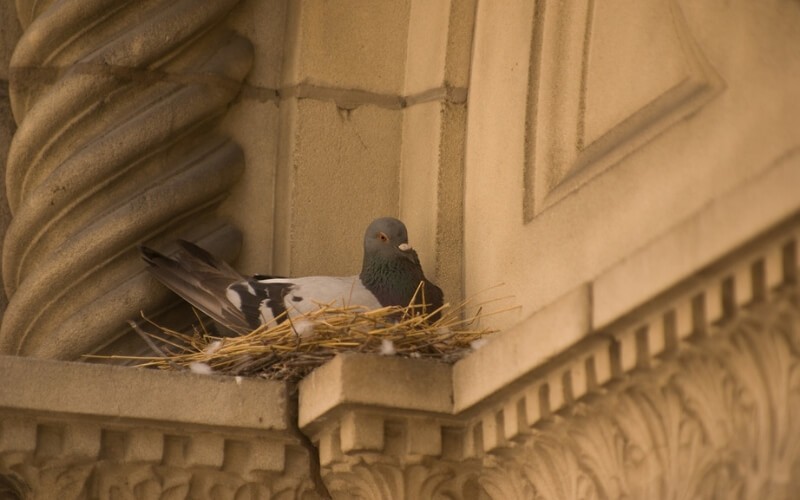
Roosting habits differ between species. Feral pigeons frequently rest in groups on rooftops, building ledges and beneath bridges, sometimes returning to the same locations regularly. Woodpigeons and collared doves commonly roost in trees, while stock doves use sheltered cavities. When feral pigeons repeatedly gather around a building, droppings and nesting material can accumulate on ledges and other surfaces.
Pigeons are also remarkable navigators. Homing pigeons are domesticated birds selectively bred for their ability to return to familiar locations, a skill historically used to carry messages, including during the Second World War. Research suggests they navigate using several environmental cues, including the Earth’s magnetic field and their sense of smell. Pigeons can also recognise individual human faces, demonstrating their ability to learn and remember familiar surroundings.
When do pigeons become a problem for properties?
Pigeons can become a nuisance when they repeatedly roost or nest on buildings, particularly around roofs, balconies, lofts and sheltered ledges. Common warning signs include accumulated droppings, feathers and nesting material, persistent bird activity and blocked gutters or drainage outlets. Over time, droppings can stain or damage surfaces, while debris from nests may obstruct ventilation openings and rainwater systems.
Before installing deterrents or carrying out maintenance, check for active nests and eggs, which are legally protected unless an applicable exception or licence permits interference. Physical measures such as correctly installed bird netting, spikes and solar panel mesh can help prevent pigeons from accessing suitable areas, provided they are appropriate for the site and do not trap or injure birds.
In areas such as roof spaces, high ledges, or under solar panels, where pigeons nest or roost, professional bird control may be necessary.
Professional Bird Control
Pigeons nesting or roosting on your property? Our bird control services provide professional proofing and deterrent solutions for roofs, balconies, and other vulnerable areas. Book bird control