




Booklice thrive in moist environments, and if you want to know how to get rid of booklice, the short answer is this: reduce indoor humidity below 50%, remove mould, vacuum infested areas, and store food in airtight containers. In severe cases, a professional pest control service is the most reliable option. Despite their tiny size, these insects can quickly multiply, leading to a booklice infestation that can be very difficult to control.
Although their name makes it seem like they can only be found in old books, booklice are happy to settle in any dark, warm, and humid place. Therefore, the more you know about them, including how they look, their characteristics and what attracts them, the better prepared you will be to prevent them from invading your home.
Keep on reading to discover everything you need to know about dealing with this pest.
TL;DR
- Booklice (psocids) are 1–2mm insects that feed on mould, fungi, and book-binding glue — not on humans.
- They do not bite and are not harmful, but some people experience allergic reactions from heavy infestations.
- The primary cause is excess humidity: reduce it below 50% to eliminate them.
- Fix leaks, ventilate bathrooms and kitchens, and remove mould to cut off their food and moisture source.
- Vacuum infested areas, freeze affected books or containers for 24 hours, and store food in airtight containers.
- Diatomaceous earth or silica aerogel applied to cracks and crevices can help in persistent cases.
- If the infestation is severe or recurring, book a professional pest control service.
Table of Contents
What are booklice and how they look?
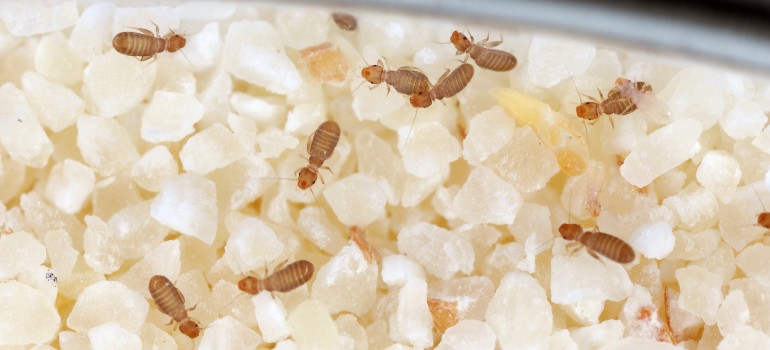
Booklice (psocids) are tiny insects, 1–2mm long, pale white to light brown in colour. They have long antennae, a distinctive bulging clypeus, and no wings in domestic species. They resemble brown sugar grains and are often mistaken for bed bug nymphs.
Psocids, also known as booklice, are a type of common household pests. They are small insects that feed primarily on mould and fungi, so they prefer dark, damp environments where mould thrives. Usually between 1mm and 2mm in size, these tiny creatures are white, grey, or light brown in colour and resemble brown sugar grains.
Booklice have two long, filamentous antennae on their heads and a distinctive bulge at the front, which is called the “clypeus” and functions as the upper “lip” of the insect. Beneath the clypeus, they have chewing mouthparts, including a chisel-shaped upper jaw that allows them to scrape and grind their food.
Due to their size, shape, and colouring, these insects are frequently mistaken for bed bugs or bed bug nymphs. However, booklice have long antennae and narrow bodies, which set them apart from bed bugs.
In the UK, there are two main species: Trogium pulsatorium, commonly present in older, slightly damp houses and Liposcelis bostrychophila, thought to be the most prevalent pest found in domestic kitchens.
How big are booklice?
Booklice are very small — typically between 1mm and 2mm in length. To put that in perspective, they are roughly the size of a grain of sugar. Of the two main UK species, Trogium pulsatorium tends to be slightly larger, reaching up to 2mm, while Liposcelis bostrychophila is at the smaller end of that range. Their size is one of the main reasons infestations go unnoticed for so long: these are not insects you spot easily across a room.
Can booklice harm you?
No. Booklice do not bite humans, do not damage property structurally, and do not transmit disease. However, large infestations of Liposcelis species can contaminate stored food, and some people develop mild allergic skin reactions from contact with shed skins or frass.
Generally, booklice are not harmful. They do not bite, inflict damage on property, or spread diseases. However, some people may experience allergic reactions due to their presence. Certain species of booklice, particularly from the genus Liposcelis, are recognised as pests of stored products, infesting pantries and contaminating items such as grains, flour, cereal, and pasta.
While booklice won’t bite you, skin irritation is documented in people exposed to heavy infestations. This is an allergic response to shed skins or droppings rather than any direct attack. If you’re finding unexplained skin irritation alongside signs of booklice, the infestation is more likely the cause than you might think.
Signs of a booklice infestation
In most cases, they do not leave much evidence of their presence, so you may not realize there is a booklice infestation in your home. However, there are some things to be cautious about:
- Eggs – Eggs laid by booklice are sticky. Individually or in groups, they can often be found on damp, moist surfaces. In some instances, eggs may be laid next to food sources, such as flour.
- Spoiled food – If you notice that some food products spoil too quickly, you may be a victim of booklice. Usually, the insect will target flour, cereals, and dried cured meat, so if you see white powder near these, it’s a sure sign that you have booklice.
- Actual booklice activity – Occasionally, you’ll see booklice in the open. They can be found on damp wood surfaces, furniture, books, magazines, or walls. Typically, in groups, they move swiftly and can often be quite unpredictable.
How to get rid of booklice
How to eliminate a booklice infestation by cutting off moisture, removing mould, and treating affected areas.
Remove mould and mildew
Mould is one of the things booklice love to eat, so removing their primary source of nutrition is the first step in eliminating booklice. As mould can also affect your health, it’s best to get rid of it as quickly as possible. It grows in bathrooms, kitchens, laundry rooms, and any areas where there is moisture. You can remove it from your house by scrubbing the area with bleach, vinegar, borax, or special products that you can get from the store. For persistent or large-scale mould problems, consider a professional mould removal service.
Reduce indoor humidity below 50%
As booklice need moisture to live, reducing humidity in your house will eliminate them. Effective ventilation is crucial, so it is important to open windows and doors frequently to allow for proper airflow and dry out any moisture. Set up dehumidifiers in damp areas like basements and bathrooms. You need to reduce humidity to below 50%. Make sure to empty the dehumidifier’s reservoir when it gets full. Another option is to increase the temperature in the affected room, as dry heat is less favourable for booklice survival.
Clean and vacuum infested areas
Remove all infested products from your cupboards and dispose of them outside. Make sure that you vacuum the crevices in the cupboards as well. Booklice can be found in other parts of your house, so vacuum those areas as well. Throw away the contents of the vacuum cleaner in a waste bin outside of your property.
Freeze affected items for 24 hours
In some cases, containers and products can be treated by freezing them for 24 hours inside plastic bags. All insects and eggs inside will die as a result. Objects such as books can also be frozen. Place them in plastic bags if you suspect that they contain eggs or booklice.
Apply dehydrating agents to cracks and crevices
Avoid using insecticide products because of possible food contamination. However, dehydrating agents such as silica aerogel, diatomaceous earth, or boric acid can be applied as dust in non-food zones, including cracks, crevices, crawl spaces, and places out of reach of children and pets, to effectively dry the affected area. Be sure to read and follow the instructions carefully.
Are you dealing with a pest infestation?
You don't have to be alone in the battle against pests. Hire a professional pest expert!
Call usWhat attracts booklice?
As their name implies, booklice are often found in locations rich in books, cardboard, and paper, such as libraries and warehouses. However, they do not consume books themselves; instead, they feed on the glue used in book bindings and the microscopic mould that develops on paper when exposed to moisture or humidity.
Booklice are frequently linked to mould in homes. Besides flour and crumbs, they feed on mould that grows in humid environments. The most common reasons for excess moisture in a property are leaking water pipes, dry plaster, or condensed moisture from not enough ventilation in the kitchen or bathroom. Booklice are also often first spotted on walls near sources of moisture or mould, so if you’re seeing tiny insects moving along a damp wall, they’re worth a closer look.
Dark, moist areas are preferred living places by booklice since they dislike disturbances or light, and they are typically found in warm, humid areas, like:
- Bathrooms
- Kitchens and pantries
- Laundry rooms
- Basements
- Storage rooms
- Boiler rooms
- Attics
- Ductwork
- Bedrooms (particularly where humidity is high or mould is present behind walls or under mattresses)
- Newly plastered walls in recently built or refurbished homes
Where do booklice come from?
Booklice typically enter homes through infested food packaging, second-hand books, or furniture. They can also establish indoors anywhere persistent moisture builds. In the UK, this is especially common around plumbing leaks, poorly ventilated bathrooms, and damp new plaster in recently built or refurbished homes. If you’ve just moved into a new build or finished a renovation and are seeing tiny insects in your walls or cupboards, fresh plaster that hasn’t fully dried is a very likely cause.
How to prevent and control booklice
- The best way to prevent booklice is to control humidity levels in your house. Use a hygrometer to monitor indoor humidity and aim to keep it consistently below 50% in all rooms, especially bathrooms, kitchens, and basements.
- Keep your bathrooms and kitchens well-ventilated by opening windows regularly. It is important to keep food storage areas aerated and cool. In case that storage in cool ventilated cabinets is not available, make sure to keep your cupboards dry.
- Patch up any leaks you find at your home.
- Don’t leave open food products for long periods of time or store them in airtight containers or bags.
- Regularly clean your cupboards, as food crumbs can accumulate in cracks and crevices.
- Check your home for leaks — no matter how minor, a leak creates the perfect living environment for booklice.
- Commercial products that combat mould and fungi will also help keep the area clean and maintain control of mould-feeding pests.
Check also:
Frequently Asked Questions about Booklice
Do booklice bite?
No. Booklice do not bite humans or animals. They have chewing mouthparts designed for scraping mould and fungal growth, not piercing skin. Any skin irritation reported near a booklice infestation is likely an allergic reaction to shed skins or droppings, not a bite.
Are booklice harmful to humans?
Booklice are not directly harmful. They don’t bite, sting, or transmit disease. However, heavy infestations of Liposcelis species can contaminate stored food products like flour, cereals, and pasta. Some people also develop mild allergic reactions, including skin irritation, from prolonged exposure to booklice allergens.
Where do booklice come from?
Booklice typically enter homes via infested food packaging, second-hand books, or furniture. They can also establish in any area with persistent moisture, particularly newly plastered walls in recently built UK homes, bathrooms with poor ventilation, or properties with leaking pipes.
Can booklice infest a bed?
Booklice can occasionally be found on or near beds if the bedroom has high humidity or if there is mould present behind a wall or under the mattress. They are not parasites and do not live on humans, but they may shelter in bedding stored in damp conditions.
How long does it take to get rid of booklice?
With consistent humidity reduction and cleaning, a minor booklice infestation typically clears within 2 to 4 weeks. Persistent infestations, particularly where mould is embedded in walls or flooring, may take longer and often benefit from professional treatment.
Conclusion
Getting rid of booklice requires a comprehensive approach focused on maintaining a dry and clean home environment. By addressing the root causes — excess moisture, mould, and improper food storage — you can prevent these tiny pests from becoming a nuisance.
In the UK, booklice are especially common in newly built homes where damp plaster hasn’t fully dried, and in older properties with poor ventilation — both conditions that can persist for months if not actively managed.
Although these pests do not pose a direct threat to your health or home, their populations can increase rapidly, making timely intervention crucial. If the infestation becomes severe, it’s best to book a professional pest control service, as they have access to specialised products and equipment not available to the general public. By taking these steps, you can effectively manage and prevent booklice in your home.



Keep Posting Good Tips. Thanks Again