




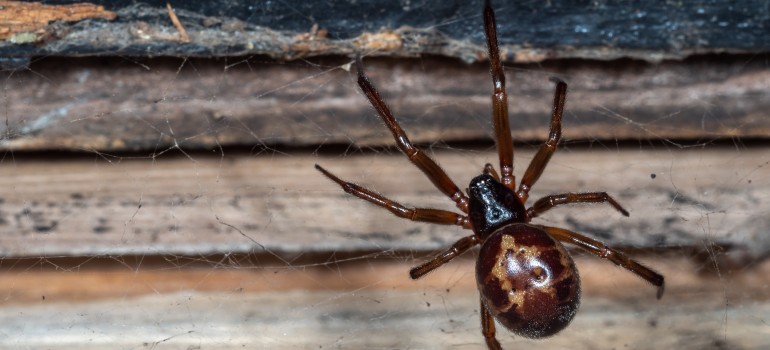
False widow spiders are among the most commonly misidentified arachnids in the UK. Their increasing presence in urban areas has sparked public interest and concern. This guide covers how to identify false widow spiders accurately and how to get rid of false widow spiders if you find one in your home.
The false widow spiders form a group of similar-looking species (Steatoda nobilis, Steatoda grossa and Steatoda bipunctata). Because they resemble the much more notorious black widow spiders (Latrodectus), false widows can cause a great deal of concern when found. The most common type is the noble false widow (Steatoda nobilis).
What to do if you find a false widow spider? Don’t panic. Although noble false widows are among the most venomous spiders in the UK, their bites are generally comparable to a bee sting and serious incidents are extremely rare.
TL;DR
- False widow spiders are brown with a glossy, bulbous abdomen, cream skull-like markings, and reddish-orange legs — body length up to 15mm.
- They’re the most venomous spider in the UK, but bites are rare and usually no worse than a bee sting.
- If you find one, a glass and piece of card is all you need — catch it and release it outside.
- Bite symptoms (pain, swelling, tingling) typically clear within 1 to 2 days without medical treatment.
- To get rid of false widow spiders, vacuum webs and egg sacs, seal entry points, and reduce clutter in garages and sheds.
- If spiders keep returning despite your efforts, a professional spider control treatment is the most reliable long-term fix.
Table of Contents
What does a false widow spider look like?
False widow spiders have a brown, glossy, bulbous abdomen with distinctive cream markings — often described as a skull-like pattern — and reddish-orange legs. The body reaches up to 15mm, or around 32mm including the legs. That reddish-orange leg colour is one of the clearest visual clues: it’s the detail most people miss when they’re trying to work out whether the spider they’ve spotted is actually a false widow or something else entirely.
The three species you’re most likely to encounter in the UK look similar but have small differences worth knowing:
False widow spiders do not build nests like other species. Instead, they create scaffold webs to catch their prey.
Inhabiting houses and buildings, false widows prefer elevated places such as the highest walls, where they hunt flying insects. In other words, they are not interested in humans at all.
Noble false widow spiders are not native to the UK. They are of Mediterranean origin and arrived on this island in banana boxes from the Canary Islands in the late 1800s. Once established, they have spread northwards, likely aided by climate change.
Learn what attracts spiders to your house
Which UK spider is it?
Pick a few traits and we’ll name the most likely common UK spider — plus a calm, honest read on whether it’s actually anything to worry about. (Spoiler: almost always, no.)
1. How big is it?
Body plus leg span — roughly.
2. What does it look like?
Pick the closest match.
3. Where did you see it?
Where it lives is a big clue.
Is it dangerous?
What to do
When does control actually make sense?
- A one-off spider is normal — especially in autumn spider season. Cup-and-card it outside.
- If you have a recurring infestation, lots of webs returning, or you’re genuinely anxious about spiders, a technician can treat and proof the property.
Want them gone — calmly and for good?
Our technicians can clear webs, treat for recurring spiders and proof your home — discreetly, across London, 24/7.
This identifier offers friendly guidance based on common traits, not a guaranteed identification — many UK spiders look alike. Almost all UK spiders are harmless and beneficial. The noble false widow is the only one that occasionally bites, and reactions are usually mild. Not medical advice: if a bite worsens, spreads, or you feel unwell, seek medical help.
Does the noble false widow spider bite?
Yes, the noble false widow spider can bite, but bites are rare and almost always defensive. Symptoms are usually mild — comparable to a bee or wasp sting — and most people recover within 1 to 2 days without medical treatment.
Indeed, false widows are capable of inflicting a painful bite, but they are not usually aggressive to humans. A bite from this type of spider is rare, and most of the time, it occurs in defensive situations such as being accidentally squashed or feeling threatened.
Some people may experience symptoms like pain and a tingling sensation in the bitten area. There may be itching and swelling as well, similar to those inflicted by bee or wasp stings. The symptoms usually last for 1 to 2 days, and most people do not need medical care to treat a false widow spider bite.
Check: How to Tell if It’s a Spider Bite or Bed Bug Bite
What to do if I find a false widow spider?
Spiders are important predators in the ecosystem. In addition to helping keep pest populations under control, they eat insects that can transmit diseases, such as mosquitoes.
Should you kill a false widow spider? No. Unless you have a genuine infestation, removal using a glass and card is always preferable. False widows are beneficial predators and pose minimal risk.
With this in mind, if you have an unwanted spider in your house, you can catch it with a glass and a piece of cardboard. Hover above the spider with the glass while it is on its net, then line a piece of cardboard on the other side and trap it in. You should then release it outside and let it carry on protecting your garden.
False widows are known to live peacefully with humans. They help keep outdoor spaces clean, eliminating unwanted insects and other small creatures that can be a nuisance.
Aside from their key role in feeding on pest insects, the silk they produce is known for its unique role in the textile industry. It is used to make special clothes, such as bullet-proof vests, and false widow venom can be used in pain treatment.
Check also:
False widow spider bite treatment
The first thing you should do if you suspect you have been bitten by a false widow spider is wash the bite area with soap and water. Then, apply a cold compress or ice pack to reduce swelling. If possible, raise the bitten area to reduce swelling. Avoid scratching the spot to prevent an infection.
Don’t panic if you have been bitten by a false widow spider. Most likely, you will only experience mild symptoms. You’ll probably feel a slight ache or pain around the bite and may see a small red spot. However, if you develop flu-like symptoms, seek medical attention immediately! Although this spider’s bite is not usually dangerous, some people can experience an allergic reaction.
How to get rid of false widow spiders
To get rid of false widow spiders, remove existing webs with a vacuum, seal entry points around doors and windows, and reduce harborage in garages and sheds. For persistent infestations, a professional spider control treatment is the most effective long-term solution.
1. Vacuum webs, egg sacs and dead spiders
Work into corners, along ceiling edges, and behind furniture. False widows build scaffold webs, so look up as well as down.
2. Seal cracks and gaps
Check around door frames, window frames, and where pipes enter the building. A tube of exterior filler deals with most of these in an afternoon.
3. Reduce clutter in garages, sheds and basements
Dark, undisturbed spaces are where false widows settle in. Clear them out and you take away the shelter they need.
4. Apply a residual insecticidal spray around entry points
Treat door thresholds, window ledges, and any gap you couldn’t fully seal. Follow the product instructions carefully.
5. Fit door seals and draught excluders
Cheap to buy, quick to fit, and they stop spiders walking in under doors — a gap you’d otherwise overlook.
6. Calling a professional
If you’re seeing false widows repeatedly — lots of webs coming back, egg sacs, or multiple sightings across the house — it’s worth calling in professional spider control. It’s not admitting defeat. It’s being sensible.
Note: Spiders are beneficial, so we advise on restricting the use of lethal methods when possible.
FAQ
Do false widow spiders come back after removal?
They can, particularly in autumn when spiders are actively searching for shelter. Removal alone is rarely enough if the conditions that attracted them — gaps in the building, clutter in garages and sheds, or an abundance of insect prey — haven’t been addressed. Sealing entry points and keeping the property clean significantly reduces the chance of them returning. If they keep coming back despite your efforts, a professional treatment can break the cycle.
Are false widow spiders more common in autumn?
Yes. Like most UK spiders, false widows are most visible from late August through October. Adult males leave their webs during this period to search for mates, which is when they’re most likely to wander into homes. Sightings tend to drop off once temperatures fall sharply in November. Sealing entry points before late summer is the best way to limit how many get inside.
How do you get rid of a false widow spider nest?
Vacuum the scaffold web and surrounding area thoroughly, including any visible egg sacs. Dispose of the vacuum contents outside immediately to prevent re-establishment.
Are you dealing with a pest infestation?
You don't have to be alone in the battle against pests. Hire a professional pest expert!
Call usTakeaways
- The key differences between a false widow and a black widow spider are size and colour. Black widows are far larger and black, while their lookalikes are brown and smaller.
- False widow spiders are not aggressive towards humans. Their venom is generally not dangerous and doesn’t require special treatment unless you have an allergic reaction.
- Keep your home spider-free by regularly vacuuming cobwebs and sealing entry points. Insecticidal sprays can be used around entry points if spiders are a persistent problem.
- Thousands of eggs are laid by a single spider, so if you see a significant increase in baby spiders in your home or yard, it may be time to call a professional pest control company.
Image source: Stephan Morris / Shutterstock



Leave a Reply