



Squirrels are everywhere. Parks, gardens, suburban streets, ancient woodlands- they dart around with a kind of frantic energy that makes you wonder if they ever stop. But what happens when the sun goes down? Where exactly does a squirrel go when it’s done racing along fence tops and burying acorns for the hundredth time that day?
It’s a question more people ask than you’d expect. Whether you’ve spotted a suspicious bundle of leaves up in a tree and wondered what it is, or you’re just genuinely curious about what goes on in your garden after dark, squirrel sleeping habits are surprisingly interesting. There’s quite a bit that most people get wrong about them too.
This post covers where squirrels actually sleep, how that changes across seasons, and what urban life has done to their habits. Let’s get into it.
TL;DR
- Squirrels build nests called dreys, typically high up in trees, using twigs, leaves, and moss.
- They’re diurnal animals, meaning they’re active during the day and sleep at night.
- In winter, squirrels nest more deeply and sleep for longer stretches, but they don’t hibernate.
- Urban squirrels adapt by using roof spaces, wall cavities, and dense park trees as sleeping sites.
- Grey squirrels are more likely to nest in tree cavities; red squirrels favour high, exposed dreys in conifers.
- Squirrels don’t share nests with birds, despite what the tangle of twigs in a tree might suggest.
Table of Contents
Where Do Squirrels Sleep?
Squirrels sleep in nests called dreys, built high up in the forks or branches of trees. A drey is a compact, roughly ball-shaped structure made from twigs, leaves, bark strips, and moss, insulated inside with softer materials like feathers, grass, or fur. Tree cavities are also commonly used, offering better shelter from wind and rain.
If you’ve ever glanced up into a tree during winter, when the branches are bare, you’ve probably spotted one without knowing what it was. They look a bit like a messy bird’s nest but tend to sit snugly in a fork rather than on an open branch, and they’re noticeably denser.
A squirrel will typically build more than one drey at a time. That’s not laziness. It’s a survival strategy. Having multiple sleeping spots means that if a predator locates one nest, the squirrel has backup options nearby. They’ll rotate between them depending on conditions, which nest feels safer, or simply which one is closer when they’re done foraging for the day.
Tree cavities, where a section of trunk has hollowed out naturally, are the premium real estate of the squirrel world. They’re warmer, better protected from the elements, and harder for predators to access. Grey squirrels in particular will use these when they’re available, sometimes lining them with nesting material to make them cosier.

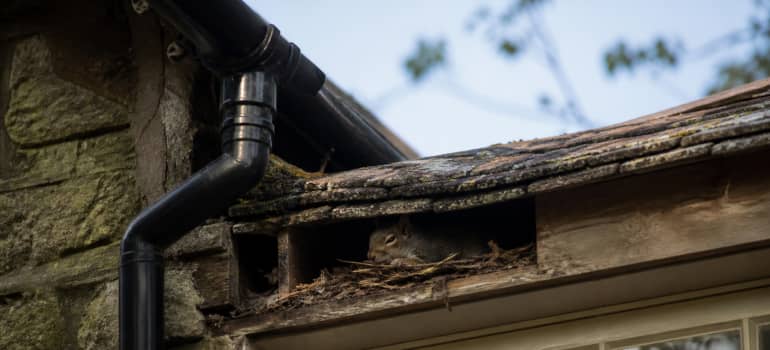
Squirrels nesting in roof voids are more common than most homeowners realise, especially in autumn when they’re scouting warm, dry sites. If you hear scratching or rustling in your loft in the early morning hours, a grey squirrel is often the culprit, and the longer it stays, the more damage it does to insulation and wiring.
Seasonal Changes: Where Do Squirrels Sleep in Winter?
As temperatures drop, squirrels don’t vanish. They’re still out there, just less so. Their sleeping habits shift considerably in winter, and understanding that shift helps explain a lot of the behaviour people notice in their gardens and local parks.
During colder months, squirrels bulk up their dreys significantly. They’ll add extra layers of insulation, packing the nest more tightly with leaves, grass, and any soft material they can find. Some will double or triple the thickness of the walls compared to a summer drey. The goal is simple: conserve body heat overnight when temperatures dip.
Squirrels also sleep for considerably longer stretches in winter. Not true hibernation, which we’ll get to shortly, but extended bouts of torpor where their body temperature drops slightly and their metabolism slows. They might stay in the nest for several days during the coldest spells, emerging on milder days to retrieve food they cached earlier in autumn.
The species difference here is worth noting. Grey squirrels, being the more robust and adaptable of the two, tend to fare better through winter using tree cavities or fortified dreys. Red squirrels are more sensitive to harsh conditions and rely heavily on their food caches. During the deepest cold snaps, red squirrels will hunker down and may share a nest with one or two others to conserve warmth, something grey squirrels rarely do outside of a mother and her young.
Check also:
Squirrel Sleeping Habits and Daily Routine
Squirrels are diurnal, which means they’re active during daylight hours and sleep through the night. They typically rise around dawn, spend the morning foraging and caching food, take a rest during the middle of the day when temperatures are highest, then get active again in the late afternoon before returning to the nest at dusk.
That midday lull is something a lot of people miss. If you’ve ever noticed squirrels seem to disappear from your garden around noon, they haven’t gone far. They’re usually tucked up in a drey taking a proper rest. It’s a rhythm that mirrors a lot of wildlife behaviour: push hard in the cooler parts of the day, rest when the sun’s at its peak.
Overnight, squirrels sleep deeply in their dreys. They don’t patrol, forage, or make noise. So if you’re hearing movement in your loft or attic during the night, it’s likely not squirrels. Rats and mice are the nocturnal culprits for that particular problem.
Do squirrels hibernate?
No. This is one of the most common misconceptions about squirrels. They don’t hibernate. True hibernation, as seen in animals like dormice, involves a sustained, dramatically lowered body temperature and metabolic rate for months at a time. Squirrels don’t do this.
What they do is spend more time in the nest during cold weather, conserving energy and relying on cached food. They might stay put for a few days during the worst of winter, but they’ll always emerge to feed when conditions allow. A squirrel you haven’t seen for a week hasn’t gone into hibernation. It’s just been sitting tight in a well-insulated drey waiting for a milder day.
Check also:
Urban Squirrel Adaptation: Sleeping Habits in Cities
Cities should be hostile places for squirrels. Concrete everywhere, limited mature trees, constant noise and human activity. Yet grey squirrels in particular have made urban environments work remarkably well for them. Their adaptability is genuinely impressive, and their sleeping habits in cities reflect that.
In parks and green spaces, urban squirrels behave much like their woodland counterparts. They’ll build dreys in mature park trees or use cavities where they find them. But the interesting stuff happens at the edges, where the park meets the street, where gardens back onto old buildings.
Grey squirrels will quite readily exploit man-made structures as sleeping sites. Roof spaces and loft voids are a favourite. They offer excellent insulation, no wind, no rain, and very few predators. If there’s a gap under a loose roof tile or a crack in the fascia board, a grey squirrel will find it. Once inside, they’ll nest using whatever material is available, including loft insulation, which they’re not shy about shredding.
Wall cavities in older buildings are another option. Squirrels have also been found nesting in garden sheds, outbuildings, and even inside dense ornamental hedges during milder months. If a spot is warm, sheltered, and reasonably undisturbed, a squirrel will consider it. That’s the core of their urban strategy: flexibility.
This adaptability isn’t without consequence for homeowners. A squirrel nesting in your loft isn’t just an interesting wildlife story. They chew, they shred insulation, and they can cause real structural issues. If you suspect squirrels have taken up residence in your property, a professional squirrel control service will assess the entry points, remove the animals safely, and proof the building against future access.
Hearing something in your loft?
Our pest control team will identify the problem, remove the animal safely, and seal the entry points so it doesn't happen again.
Contact usRed vs. Grey Squirrels: How Their Sleeping Habits Differ
Red and grey squirrels are quite different animals when it comes to where and how they sleep, and lumping them together does both species a disservice.
| Red Squirrel | Grey Squirrel | |
|---|---|---|
| Nest type | Primarily dreys in conifers and dense woodland | Dreys and tree cavities; more varied |
| Nest location | High up, often in Scots pine or spruce | Varied height; lower and in broader tree species |
| Urban nesting | Rare; red squirrels avoid built-up areas | Common; readily uses roof spaces and outbuildings |
| Winter sharing | Sometimes shares nest for warmth | Rarely shares except mother with young |
| Habitat in UK | Scotland, parts of northern England, some islands | Widespread across England, Wales, and lowland Scotland |
Red squirrels in the UK are largely confined to Scotland, parts of Northumberland, and a handful of islands where grey squirrels haven’t gained a foothold. They’re woodland specialists and strongly prefer conifer-dominated habitats. Their dreys tend to be built higher up than grey squirrel nests and are often tucked tightly against the trunk of a conifer for stability and windproofing. The dense canopy of a spruce or pine plantation gives them natural protection from predators like goshawks and pine martens.
Grey squirrels are far less picky. They’ll build dreys in almost any broadleaf or mixed woodland, at various heights, and as already covered, they’re completely willing to move into man-made structures. Their nests tend to be larger and bulkier than red squirrel dreys, partly because grey squirrels are bigger animals.
One thing both species share is the habit of building multiple nests. Whether red or grey, a squirrel rarely commits to a single sleeping site. They move between several dreys regularly, which makes it tricky to track individual animals and is one reason people often overestimate how many squirrels are in their garden. Three dreys doesn’t mean three squirrels. It might just mean one very cautious one.
Check also:
Frequently Asked Questions
Do squirrels sleep in nests?
Yes, squirrels sleep in nests called dreys. These are compact, ball-shaped structures built from twigs, leaves, bark, and moss, lined inside with softer material for warmth. Squirrels also use natural tree cavities when available, which offer better protection from wind and rain. A single squirrel typically maintains several nests and rotates between them.
How long do squirrels sleep each night?
Squirrels sleep through the entire night, from dusk to dawn. In winter they may also spend additional daytime hours resting in the nest during cold snaps, since their metabolism slows and they conserve energy between foraging trips. They don’t sleep in short bursts the way some mammals do. Once settled for the night, they stay put.
Can squirrels and birds share a nest?
No. Squirrels and birds don’t share nests. Their nest structures are very different in design and purpose, and a squirrel occupying a tree cavity or drey will deter birds from using the same spot. The confusion often arises because dreys and bird nests can look similar from a distance, especially in a leafless winter tree. They’re built by different animals for different reasons.
What time do squirrels go to sleep?
Squirrels typically return to their nest around dusk and stay there until dawn. The exact time shifts with the seasons. In midsummer, they may stay active later in the evening, while in winter they’ll head back to the nest earlier. They’re rarely active after dark and very rarely before first light.
Do squirrels sleep in the same place every night?
Not always. Squirrels build multiple dreys and rotate between them. They might use a preferred nest most nights but switch if they sense a predator nearby, if the nest is damaged, or simply out of habit. This behaviour is a survival mechanism. Predictability can be fatal when you’re small, slow on the ground, and on the menu for several local predators.
Ready to get the problem sorted?
Don't wait for squirrel damage to get worse. Get in touch and our team will take it from there.
Contact usConclusion
Squirrels are a lot more interesting than their reputation as garden nuisances gives them credit for. Their sleeping habits, from the carefully constructed drey to the opportunistic loft invasion, tell the story of an animal that’s genuinely good at surviving in a changing world. They’re diurnal, adaptable, and far more strategic about where they sleep than most people realise.
Next time you spot a tangle of twigs high up in a park tree or hear rustling in your roof on an autumn morning, you’ll know exactly what’s going on. Whether you find that charming or slightly alarming rather depends on whether the squirrel is outside or in.