



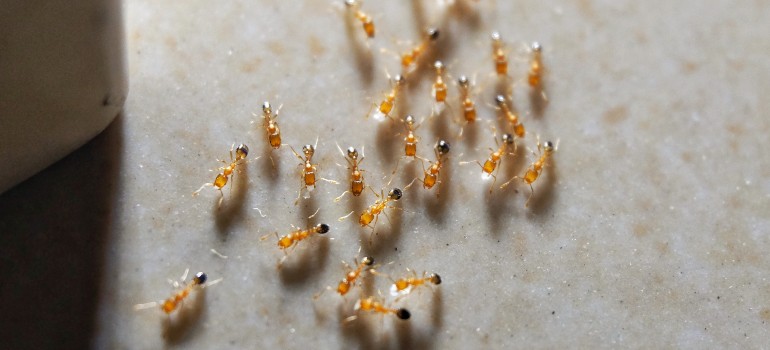
Knowing how to get rid of pharaoh ants is trickier than it sounds. These tiny, persistent insects are among the most difficult household pests to eliminate in the UK, and the wrong approach can actually make things worse. Their colonies are large, their queens are numerous, and a single mistake with the wrong product can split the infestation and spread it further through your home.
This article will walk you through effective strategies and practical tips to eradicate and prevent this type of ant. You’ll also learn what causes pharaoh ants and what they like to eat.
TL;DR
- Pharaoh ants are a tropical species found in heated buildings across the UK, including hospitals, hotels, and blocks of flats.
- Never use sprays or repellent insecticides on pharaoh ants — this causes the colony to fragment and spread into multiple satellite nests, making the problem significantly worse.
- The correct DIY approach is non-repellent gel bait, placed along active trails, so workers carry the toxicant back to the queens.
- Professional treatments use insect growth regulators (IGRs) such as methoprene to disrupt the breeding cycle and prevent colony recovery.
- Pharaoh ants can bite, but the bites are mild and rarely felt. The real risk is disease transmission: they carry bacteria including Salmonella and Streptococcus.
- They are considered a serious pest in NHS and healthcare settings because of the infection risk they pose in sterile environments.
- Elimination takes weeks to months depending on colony size — patience and consistency with bait placement are essential.
Table of Contents
Are pharaoh ants in the UK?
Yes, pharaoh ants are well established in the UK. They’re not a native species, and they can’t survive outdoors in the British climate, but they thrive inside heated buildings all year round. You’ll find them in homes, but they’re far more commonly a problem in larger structures where warmth, moisture, and food sources are consistently available.
The buildings most often affected in the UK are hospitals, care homes, hotels, blocks of flats, and food-processing facilities. In NHS settings in particular, pharaoh ants are treated as a serious pest risk because they can travel through ward environments and contaminate sterile areas. They’re sometimes referred to as “tropical ants” in the UK pest control industry, which reflects their origin and their need for constant warmth to survive.
Originally from Egypt and other tropical regions, pharaoh ants spread across the world through trade and travel. In the UK, they live entirely indoors, moving freely through buildings via wall voids, pipework, and service ducts without ever needing to go outside. A colony can span an entire floor of a block of flats without anyone realising they’re connected.
Among the most common places to find pharaoh ants are kitchens, especially near ovens and other appliances that give off heat. In larger buildings, they gravitate towards boiler rooms, airing cupboards, and anywhere with consistent warmth and access to water.
Can pharaoh ants bite?
Yes, pharaoh ants can bite, but you’ll barely feel it. Their mouthparts are small, the bite causes only the mildest irritation, and they are not venomous. Most people only notice a pharaoh ant bite after the fact, if at all. They bite when disturbed or threatened, not as a regular behaviour.
The real danger from pharaoh ants has nothing to do with the bite itself. These ants are known to carry and transmit bacteria, including Salmonella and Streptococcus, as they travel through kitchens, food storage areas, and in healthcare settings, through patient wards and dressing stations. That’s why “are pharaoh ants dangerous?” gets a more serious answer than you might expect for such a tiny insect. They’re not dangerous in the sense of being venomous or aggressive. They’re dangerous because of where they walk and what they pick up along the way. In a hospital or care home, that’s a genuine infection risk. In a domestic kitchen, it’s a real food hygiene concern.
Common signs of a pharaoh ant infestation
Seeing live ants in your house is, of course, the first sign of a pharaoh ant infestation. However, other signs can also indicate you have an ant problem, such as seeing ant trails and finding a nest.
When an infestation is detected, you should take appropriate measures for ant control. The following are some common signs of pharaoh ant infestation:
- Live ants: You’ll likely see trails or clusters of ants near food, water, or nesting areas. It’s common to find these insects in kitchens, bathrooms, or other places where food is stored or prepared. Distinguishing pharaoh ants from other species can be challenging, as several ant species share similar characteristics. If you’re unsure, a pest control professional can help you confirm the type of ant you’re dealing with.
- How to identify pharaoh ants: A pharaoh ant has a small, light-coloured body around 2 mm in length. Colouring ranges from yellow to red, with the abdomen typically darker, red to black. Pharaoh ant queens are generally darker than workers. Their antennae are bent or elbowed, and often longer than their bodies.
- Ant trails: Pharaoh ants follow defined trails as they forage for food. You may see these trails on walls, countertops, or other surfaces. These trails can shift as the colony establishes new foraging routes.
- Nesting sites: Pharaoh ant nests are often hidden and hard to spot. Wall voids, baseboards, cabinets, electrical outlets, and appliances are common nesting sites. A small pile of ant debris, such as soil or insulation material, near a gap or crack may indicate a nest nearby.
- Multiple ant colonies: Pharaoh ants are unique in forming multiple colonies with multiple queens. Finding several ant nests or satellite colonies spread throughout your property is a strong indicator of an established infestation.
- Food invasion: Sugar, fruits, meats, and small insects are all on the pharaoh ant menu. Their preference for sugary foods is similar to that of sugar ants. Fatty or oily foods such as grease and cooking oils attract them too. If you spot ants feeding on crumbs or spills, or clustering around pet food bowls, that points to an active infestation.
If you detect any of these signs, act promptly. Managing a pharaoh ant infestation on your own is genuinely challenging because of how these ants nest and reproduce. We’ve outlined DIY methods below, but if the infestation is large or persistent, calling a professional ant exterminator is the more reliable route.
Read also about: Flying Ants and Zombie Ants – It’s a Real Thing
How to get rid of pharaoh ants
Here’s how to stop a pharaoh ant infestation and eradicate the colony properly. The order of these steps matters, so work through them in sequence:
How to eliminate a pharaoh ant infestation using bait-based methods — the only approach that reaches the entire colony without causing it to fragment and spread.
Locate ant trails
Observe the ants’ movements and track the trails leading to and from their nesting areas. Don’t disturb them at this stage. The trails tell you exactly where to place bait for maximum effect — workers need to be able to find and carry it back freely.
Use gel bait, not spray
This is the most important step. Never use sprays or repellent insecticides on pharaoh ants. Doing so causes the colony to ‘bud’ — the queens sense the threat, split the colony, and disperse into multiple satellite nests. You end up with a larger, harder-to-treat infestation than you started with.
The correct approach is a non-repellent ant gel bait. Products based on non-repellent active ingredients (such as those in professional-grade gel baits) allow worker ants to feed on the bait and carry it back to the queens and larvae deep in the nest. The colony is eliminated from the inside out. Place bait along active trails, near nest sites, and anywhere you see regular ant activity.
For a limited natural option, a mixture of baking soda and equal parts sugar can be placed along foraging routes — the rationale is that formic acid in ants reacts with the baking soda — but this is a very slow and unreliable method compared to proper gel bait, and should not be relied on for an established infestation. Do not use vinegar sprays on pharaoh ants. Vinegar is a repellent, and repellents cause colony budding — the exact outcome you’re trying to avoid.
Position bait correctly
Place bait stations or gel drops along the full length of active trails, not just at one point. Pharaoh ants forage across wide areas, so thin coverage means a large proportion of the colony never encounters the bait. Focus on wall edges, behind appliances, under sinks, and near any identified nesting sites.
Monitor and replenish
Check bait placements every few days. Replenish gel or replace bait stations as they are consumed. If ants stop feeding at a particular spot, move the bait slightly — the trails can shift. Persistence is essential here. It can take several weeks to several months to see full results, depending on the size of the colony.
Remove food sources
Keep your kitchen and dining areas clean. Wipe up spills promptly, store food in airtight containers, and take out the rubbish regularly. Reducing competing food sources makes the bait more attractive and speeds up the process.
Seal entry points
Once the active infestation is under control, seal cracks in walls, gaps around pipework, and other entry points to reduce the chance of re-infestation. Use caulk or appropriate filler for small gaps.
Call a professional if needed
If the infestation is large, covers multiple rooms or floors, or keeps returning despite consistent bait treatment, it’s time to bring in a professional. Professionals have access to insect growth regulators (IGRs) such as methoprene, which disrupt the pharaoh ant breeding cycle at a hormonal level, preventing larvae from developing into reproductive adults. IGRs don’t kill the colony quickly, but used alongside gel bait they effectively prevent colony recovery. For infestations in multi-occupancy buildings or healthcare settings, professional pest control is the only realistic solution. Contact a professional pest control company if your DIY efforts haven’t resolved the problem within a few weeks.
Why do I have pharaoh ants?
Food is the main draw. Sugary substances, proteins, and greasy residues are what attract and sustain pharaoh ants, and a kitchen that isn’t spotlessly maintained gives them everything they need.
Beyond food, these ants need warmth and moisture to thrive. If you’re finding pharaoh ants in your home, the conditions are almost certainly right for them: sufficient temperature, humidity somewhere nearby, and a reliable food supply.
Pharaoh ants are particularly drawn to hospitals and multi-occupancy buildings because the constant warmth, pipework humidity, and distributed food sources closely mimic the tropical conditions they originate from. In a large building, they can establish a network of interconnected colonies spanning multiple floors without any single colony being particularly large or obvious.
Their preferred nesting sites are hidden and protected: wall voids, electrical outlets, cabinets, and other enclosed spaces that offer stable conditions close to food and water.
Ways to prevent a pharaoh ant’s invasion
Here are a few pest-proofing measures that you can take to prevent pharaoh ants from entering your home and causing a new infestation:
- Seal entry points: Check your home for cracks, gaps, or openings where ants can enter. Using caulk or weatherstripping will prevent ants from accessing them.
- Clean: Again, ensure cleanliness in your living areas, especially the kitchen and dining areas. Spills should be cleaned promptly, and sweeping or vacuuming should be done regularly. You should eliminate any potential sources of food that may attract pharaoh ants.
- Trash disposal: Ensure garbage is properly disposed of by sealing garbage bags tightly and placing them in outdoor trash cans. To avoid ant infestations, regularly empty trash cans and clean the area around them.
- Storing food: Store all food items in airtight containers, including pet food. As a result, ants cannot detect and access possible food sources.
- Fix leaks: Moisture attracts pharaoh ants. If you discover a leak or plumbing issue, fix it quickly. Maintain proper ventilation to reduce excess moisture in areas like bathrooms, kitchens, and basements.
- Remove outdoor attractants: Keep outdoor areas clean and free of debris that may attract ants. Don’t leave food or sugary substances outside; trim vegetation away from your home’s exterior.
- Check new items: Take caution when bringing new items into your home. Ensure that used furniture, potted plants, or other items have been inspected. A pharaoh ant can hitch a ride on an infested item and enter your home.
These preventive measures will significantly reduce your chances of a pharaoh ant infestation in your home. Cleanliness and maintenance play a crucial role in preventing ants and other pests.
Frequently Asked Questions
How long does it take to get rid of pharaoh ants?
Expect several weeks to several months, depending on colony size, how consistently you apply bait, and how well you’ve cut off competing food sources. Pharaoh ant colonies are complex, with multiple queens and satellite nests — there’s no quick fix. Large infestations in multi-occupancy buildings very often require professional pest control to fully resolve.
Why shouldn’t you spray pharaoh ants?
Spraying pharaoh ants with repellent insecticides — including most standard ant sprays — causes the colony to ‘bud’. The queens detect the chemical threat, split the colony, and move into multiple new satellite nests throughout the building. What started as one problem becomes several. Only non-repellent gel bait works correctly: workers carry it back to the queens and larvae, eliminating the colony from the inside without triggering dispersal.
Can pharaoh ants survive in the cold?
No. Pharaoh ants are a tropical species and cannot survive outdoors in the UK climate. Every infestation is found inside a heated building. If ambient temperature drops consistently below around 18°C, colonies collapse. This is why infestations in the UK are always indoors, and why they’re so prevalent in centrally heated homes, hospitals, and hotels where warmth never really switches off.
What is a pharaoh ant queen, and how many are there per colony?
Unlike most ant species, which have a single queen, pharaoh ant colonies can contain hundreds of queens. This is the root cause of why conventional spray treatments fail so completely: killing workers does nothing to stop the reproductives, who continue laying eggs and expanding the colony. It’s also why colony budding from spray treatments is so damaging — each fragment already contains multiple queens, so each satellite nest is immediately self-sustaining. Effective treatment has to reach and eliminate those queens, which only slow-acting gel bait (carried by workers back into the nest) can reliably do. You can read more about ant queens and how their role differs between species.
Takeaways
- Pharaoh ants are a tropical species found in heated buildings across the UK, including hospitals, care homes, hotels, and blocks of flats.
- Due to the similar characteristics of several species of ants, it can be difficult to identify them without professional help.
- Multiple queens and multiple colonies make pharaoh ants uniquely difficult to eradicate.
- Using sprays or repellent insecticides on pharaoh ants can cause the colony to split and spread into multiple satellite nests — always use non-repellent gel bait instead.
- To control pharaoh ants, non-repellent gel bait is significantly more effective than sprays or bait stations alone.
- Professional ant control treatment is required if you cannot deal with the infestation yourself — professionals use insect growth regulators (IGRs) alongside gel bait for the most reliable results.
Image source: Najmi Arif / Shutterstock.com