




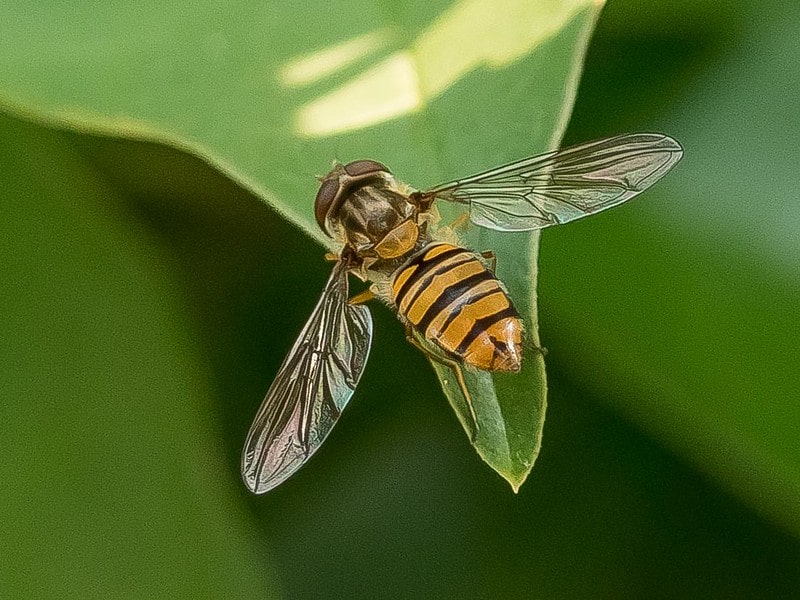
Spotted a black and yellow flying insect and not sure if it’s a hoverfly vs wasp? You’re not alone. Hoverflies are remarkably good mimics — they’ve evolved to look almost identical to wasps, right down to the yellow and black banding. The difference matters, though. One can sting you repeatedly. The other is completely harmless and is quietly doing your garden a favour.
The fly that looks like a wasp is called a hoverfly. In this article, we’ll identify both insects and lay out the main differences between them so you can tell them apart at a glance.
TL;DR
- Hoverflies cannot sting — they are completely harmless to humans.
- Wasps have two pairs of wings; hoverflies have just one pair.
- Hoverflies hover motionless in mid-air; wasps have a distinctive bouncing flight pattern.
- A hoverfly has short, stubby antennae; a wasp’s antennae are long and thin.
- Hoverflies lack a defined waist; wasps have a narrow “waist” connecting thorax and abdomen.
- Hoverfly larvae eat aphids, making them useful in the garden; adult hoverflies feed on pollen and nectar.
- There are around 280 species of hoverfly in Great Britain — they are the UK’s most important pollinating flies.
Table of Contents
Hoverfly Identification
Hoverflies — also called flower flies — belong to the insect family Syrphidae. They’re the most important pollinating flies in the UK, with around 280 species recorded in Great Britain. At first glance, a hoverfly looks convincingly like a wasp or bee. That’s the point: the resemblance puts predators off. Up close, though, the differences are clear. Here’s what to look for in a hoverfly vs wasp comparison.
Appearance
- Antennae: short and stubby — noticeably thicker and shorter than a wasp’s
- Eyes: large and rounded, taking up much of the head. Males often have even larger eyes, which help them spot females mid-flight.
- Wings: just one pair, broad and slightly transparent. When resting, the wings form a shallow V shape across the back.
- Abdomen: no well-defined waist — the body flows more smoothly from thorax to abdomen than a wasp’s does.
- Colouration: bright yellow and black markings, mimicking a wasp’s warning colours.
Behaviour
Do hoverflies sting? No. Hoverflies cannot sting at all. They have no sting and no venom. If one lands on you, it’s curious about salt or moisture on your skin — not threatening you. You can leave it alone without any worry.
- Sting: hoverflies do not sting and cannot bite in any harmful way.
- Flight: the giveaway. Hoverflies hold completely still in mid-air — suspended like a tiny helicopter — before darting off. No other common UK insect does this so precisely.
- Diet: hoverflies eat differently depending on their life stage. Larvae feed on aphids, making them a natural form of pest control in gardens. Adults feed on pollen and nectar from flowers, which makes them valuable pollinators. Some species’ larvae instead feed on decaying plant matter or live in standing water.
Habitat
Different hoverfly species occupy different spots. Larvae are commonly found near standing water, rotting wood, or close to aphid colonies on plants. Adults hover around flowers — that’s their primary food source. Some species take things a step further and move into bumblebee or wasp nests, where they’re tolerated because they cause no harm to the colony. Trees and compost heaps are also common spots. Hoverflies don’t build nests of their own — if you’ve found what you think is a hoverfly nest, it almost certainly belongs to a wasp or bee that the hoverflies have moved in on.
Wasp Identification
Wasps are one of the most recognisable stinging insects in the UK. In summer they’re everywhere, and their defensive sting is no joke. Here’s how to tell them apart from the harmless hoverfly.
Appearance
- Antennae: long, thin, and clearly segmented — much more prominent than a hoverfly’s.
- Eyes: noticeably smaller than a hoverfly’s, kidney-shaped rather than rounded.
- Wings: two pairs. The front wings are larger than the hind wings, and at rest they fold flat along the body rather than spreading in a V.
- Abdomen: wasps have a clearly defined narrow waist — a tight connection between the thorax and abdomen that hoverflies simply don’t have.
- Colouration: varies by species, from the classic yellow and black banding to red-orange tones in some.
Behaviour
- Sting: female wasps and the queen can sting, and unlike bees, they can sting more than once. Males cannot sting.
- Flight: wasps have a distinctive bobbing, up-and-down flight pattern — quite different from the motionless hovering of a hoverfly.
- Diet: wasps are hunters, scavengers, and omnivores. Larvae are fed caterpillars and other insects by the worker wasps. Adults eat fresh or rotting fruit, nectar, and scraps of meat — which is why they turn up at every outdoor meal in August.
Check also:
How to Get Rid of a Wasp’s Nest
Habitat
Wasps are very common across Britain. They usually build their own nests from chewed wood pulp, hanging them from trees, roof eaves, shed roofs, bushes, and wall cavities. Wasps are social insects and tend to nest close to where humans live, which is part of why encounters are so frequent in summer.
Hoverfly vs Wasp: Key Differences at a Glance
Here’s a quick side-by-side so you can settle a hoverfly vs wasp identification in seconds.
| Hoverfly | Wasp | |
|---|---|---|
| Can it sting? | No — completely harmless | Yes — females and queens can sting repeatedly |
| Wings | One pair, broad, V-shape at rest | Two pairs, folded flat at rest |
| Antennae | Short and stubby | Long and thin |
| Eyes | Large and rounded | Small, kidney-shaped |
| Waist | No defined waist | Narrow, clearly defined waist |
| Flight | Hovers motionless in mid-air | Bouncing, up-and-down flight |
| Diet (adult) | Pollen and nectar | Fruit, nectar, insects, meat scraps |
| Nests | No nest of its own | Builds papery nest from chewed wood |
| Threat to humans | None | Can sting if threatened |
Do hoverflies sting?
No. Hoverflies cannot sting at all. They carry no venom and have no stinger. The yellow and black markings are a defence mechanism — mimicking wasps to deter predators — but hoverflies are completely harmless to humans.
Can hoverflies bite?
Hoverflies do not bite in any way that causes harm. They have no mouthparts capable of breaking human skin. If one lands on you, it’s looking for moisture or salts — not attacking you.
What do hoverflies eat?
It depends on the life stage. Hoverfly larvae feed on aphids, decaying plant matter, or organic material in standing water depending on the species. Adult hoverflies feed on pollen and nectar, making them important pollinators in the UK.
Do hoverflies make nests?
No. Hoverflies do not build or maintain nests of their own. Some species lay their eggs inside wasp or bumblebee nests, where the larvae develop without disturbing the colony. If you’ve spotted what looks like a hoverfly nest, it’s almost certainly a wasp or bee nest.
Are there other insects in the UK that look like wasps?
Yes. As well as hoverflies, several other UK insects mimic wasps, including certain bee species, hornet hoverflies (Volucella zonaria), and some moths. The key identifiers — wing count, waist shape, and flight pattern — help distinguish them from true wasps.
Are you dealing with a pest infestation?
You don't have to be alone in the battle against pests. Hire a professional pest expert!
Call usConclusion
The hoverfly vs wasp question is easier to answer than it looks once you know what to check. Look at the wings first: one pair means hoverfly, two pairs means wasp. Then check the waist: a hoverfly’s body flows smoothly, while a wasp has that tight, pinched connection between thorax and abdomen. And if the insect is hanging perfectly still in mid-air, it’s a hoverfly without question. Hoverflies cannot sting, don’t build nests, and are genuinely useful to have around. Wasps are a different matter entirely — if you’ve got a nest on your property, that’s worth dealing with sooner rather than later. You can also find out more about bees, wasps and other flying stinging insects to help with identification.


Leave a Reply