




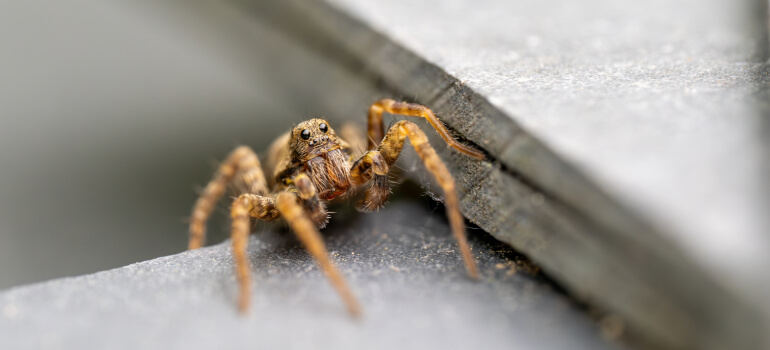
The house wolf spider is one of the most commonly encountered large spiders in UK homes and gardens, particularly in autumn when they push indoors looking for warmth and mates. If you’re afraid of spiders, this one will probably make your heart pound. The good news is, they’re harmless — and genuinely fascinating once you know what you’re looking at.
TL;DR
- Wolf spiders are large, hairy hunters found in UK homes, gardens, garages, and sheds — especially in autumn.
- They do not spin webs; instead they chase and pounce on prey like beetles, cockroaches, and grasshoppers.
- They have eight eyes, with two notably large ones that reflect light at night.
- Their bite is venomous but not dangerous to healthy humans — symptoms are mild, similar to a bee sting.
- Female wolf spiders carry their egg sac (up to 360 eggs) beneath their body, then carry spiderlings on their back for about a week.
- If you find one indoors, use a glass and card to catch and release it — do not squash it if it may be carrying eggs.
- They are harmless to humans and beneficial to gardens, helping control pest insect populations.
Table of Contents
What is a wolf spider?
Wolf spiders are part of a spider family called Lycosidae; it comes from the Greek word “Lycos”, meaning “wolf.” They are found throughout the UK, making them one of the most widespread spider species in the country.
The wolf spider is the sprinter of the spider world. Its body size can range from 0.5 to 2 inches and it’s usually dark grey, brown or black. The wolf spider is also quite hairy. Its habitat most often includes gardens, grasslands, and various other places, sunbathing or running. In the house, you may see them in garages or basements, as well as inside the garden shed if you have one.
The female wolf spider trails a silk dragline as a safety line. Male wolf spiders can even ‘taste’ that silk with their palps to tell whether the female is ready to mate.
As for the wolf spider’s lifespan, the females tend to live longer. The males can live up to a year, while the females can live 2 years or more.
Check also: UK Spiders – Dangerous or Beautiful?
What does a wolf spider eat?
The most common perception about spiders is that they create webs to catch prey, but there are entire spider families that don’t. A wolf spider does not wait for dinner to arrive. Instead, they tend to chase and pounce on their insect prey, just like wolves.
Spiders like these have excellent eyesight and a great sense of touch, making them outstanding hunters. Since they do not weave webs, their diet mainly consists of beetles, cockroaches, grasshoppers, and other large insects.
Spiders cannot chew or swallow, which is why they eat only liquid foods. As soon as the wolf spider catches their prey, they inject venom, which contains digestive enzymes, making the internal organs liquefied into a smoothie. Spooky!
Read also: False Widow Spiders: How to Spot and Get Rid of Them
The wolf spider’s eyes
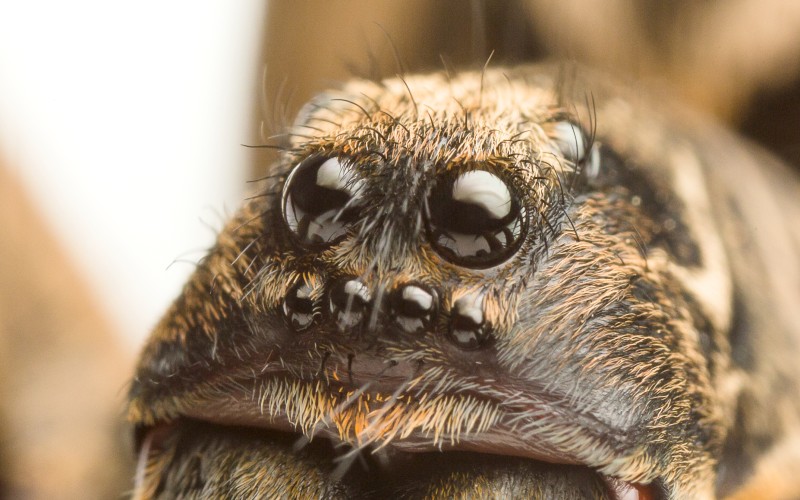
The wolf spider has two large eyes. More precisely, they have eight eyes altogether, but two of them are particularly big. Sometimes, they even give themselves away at night because these large eyes reflect light like a mirror.
There is only one problem with these eyes: they don’t move like ours. Getting to see what a wolf spider desires requires movement of the body. Although inconvenient, they can cope.
Are wolf spider bites poisonous?
Wolf spider bites are not considered dangerous to humans in the UK. They do possess venom, which they use to subdue insect prey, but it is not medically significant to healthy adults. A bite may cause localised redness, mild pain, and swelling — similar to a bee sting — and typically resolves without treatment.
Like all spiders, wolf spiders can bite when they feel threatened. Their venom is used to immobilise prey rather than as a defence against large animals, so a bite on a human is usually a last resort and causes minimal harm. Depending on the person, symptoms could vary, including redness, mild pain, and swelling. If you are more sensitive or notice severe symptoms like difficulty breathing, then you should definitely seek medical help.
Learn: UK Spiders – Dangerous or Beautiful?
Do wolf spiders carry babies on their back?
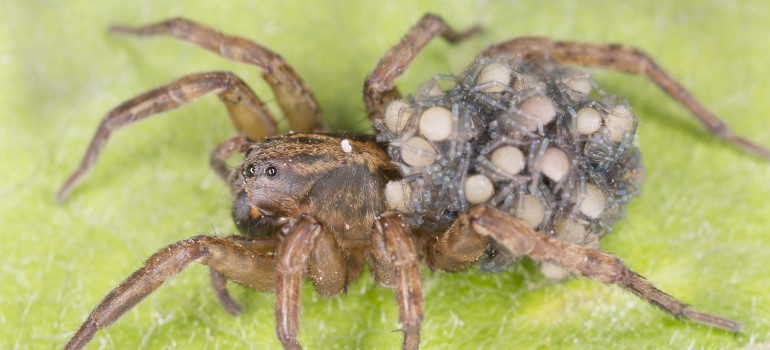
A female carries an egg sac beneath her body near the silk-producing organs called spinnerets. A single egg sac can contain up to 360 eggs during the reproduction period. It is beyond question that this is a matter of motherly care. As the spiderlings grow, the female opens the sac, and her offspring climb up the hair on her body and abdomen.
Her nurturing does not end there, though. It takes her a week to carry them until they are ready to go on with their lives. A passionate caretaker of her young, the wolf spider female demonstrates a devotion not commonly seen in other arachnids. Very few other spider species are known to carry their young this way.
Did you know? Silk “parachutes” help young wolf spiders disperse through the wind.
Why you shouldn’t squish a wolf spider
Just a warning… You must not step on this spider if you find it in your home. Dare to squash a female wolf spider, and hundreds of baby spiders will be released into your home. While they probably won’t live for long, the sight of hundreds of baby spiders is often startling.
Read also: When is Spider Season in the UK and How To Prepare
What should I do if I see a wolf spider?
There’s no need to panic. Wolf spiders are not interested in you — they play a vital role in the ecosystem by controlling pest populations, and they eat mosquitoes that can transmit diseases. The instinct to keep your distance is understandable, but these spiders genuinely pose no threat to you or your family.
If you find one indoors, catching and releasing it is straightforward. All you need is a glass and a piece of stiff cardboard.
How to safely catch and release a wolf spider found indoors.
Place a glass over the spider
Lower a glass or jar over the wolf spider from above, moving slowly to avoid startling it.
Slide card underneath
Carefully slide a stiff piece of cardboard under the rim of the glass to seal the spider inside.
Release it outside
Carry the glass outside and lift the card to release the spider into the garden, away from the house entrance. It will continue to help control pest insects in your garden.
Tools:
- glass or jar, stiff cardboard
Since spiders are beneficial, it would be wise to limit the use of lethal methods whenever possible. If your fear of spiders is genuinely affecting your daily life, learning more about them is one of the most practical first steps. Understanding what you’re actually dealing with takes a lot of the edge off.
Frequently Asked Questions about Wolf Spiders in the UK
Are wolf spiders common in UK houses?
Yes — wolf spiders are among the most frequently encountered large spiders in UK homes, particularly in autumn when they move indoors seeking warmth and mates. They are not a sign of infestation and typically enter alone.
How do I identify a wolf spider in the UK?
UK wolf spiders are typically 10–35 mm in body length, dark brown or grey with a distinctive striped or mottled pattern on their back. They are hairy, low to the ground, and fast-moving. Unlike most spiders, they do not build webs. Their two large forward-facing eyes are the clearest distinguishing feature.
When are wolf spiders most active in UK homes?
Wolf spiders are most commonly spotted indoors in the UK between late August and October, when males roam in search of mates. They may also enter homes year-round through ground-level gaps in walls, doors, and flooring.



Very much appreciated. Thank you for this excellent article. Keep posting!