



A mouse in the house is never just a minor inconvenience. Sure, the scratching noises at night are annoying enough on their own, but the real danger hides out of sight, tucked behind walls, beneath floorboards, and up in the loft. Mice chew wires. It’s what they do. Left unchecked, that habit can cause electrical fires, power outages, and damage that costs a serious amount to put right.
The problem is, most people don’t notice until something goes wrong. A light flickers. A circuit trips. Suddenly you’re wondering whether that’s a fault in the wiring or something with four legs causing chaos behind the skirting board. Knowing how to tell if mice are chewing on wires could quite literally save your home. This post walks you through what to look for, how to inspect safely, and what to do next.
TL;DR
- Mice chewing on wires is a leading cause of unexplained house fires in the UK.
- Flickering lights, tripped circuits, and unexplained power cuts are early warning signs.
- Look for gnaw marks, stripped insulation, and droppings near electrical outlets or cables.
- Always switch off the power before inspecting any potentially damaged wiring.
- Minor insulation damage can be taped temporarily, but significant damage needs a qualified electrician.
- Seal entry points and use rodent-proof cable covers to prevent future damage.
Table of Contents
How to Tell if Mice Are Chewing on Wires
The clearest signs that mice are chewing on wires include flickering lights or unexplained power cuts, gnaw marks on visible cables, frayed or stripped wire insulation, and mouse droppings found near electrical outlets, fuse boxes, or appliances. Any one of these on its own deserves attention. More than one together means you need to act fast.
Let’s break those down properly, because some of them are easy to miss if you’re not looking in the right places.
Flickering lights and unexplained power cuts
This is usually the first thing people notice. A light that flickers occasionally might seem like a bulb on its way out. Fair enough. But if it keeps happening, or if you’re getting tripped circuits without any obvious reason, that’s worth taking seriously. Mice chew through the insulation on wires, and when bare wires touch each other or surrounding materials, you get short circuits. Intermittent faults like these are a classic result.
Don’t just reset the circuit and move on. That flickering light could be telling you something important.
Visual gnaw marks and damaged insulation
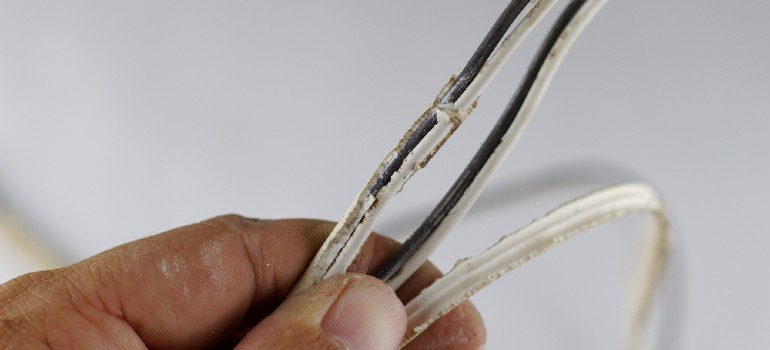
If you can actually see cables, have a look at them. Mice leave distinctive gnaw marks, small and slightly uneven, often in pairs where their two front teeth have worked away at something. Cables with chewed or stripped insulation are an obvious red flag. The outer plastic coating will look scraped, rough, or completely missing in patches.
Check anywhere cables run along walls, under floorboards, or through loft spaces. These are the spots mice tend to travel, so these are the spots they tend to chew.
Droppings and urine marks near wiring
Mouse droppings are small, dark, and shaped a bit like a grain of rice. If you spot them near plug sockets, behind appliances, around your fuse box, or along the route of any visible cabling, that’s a solid indicator mice have been active in that area. Urine trails are harder to spot with the naked eye but give off a distinctive musty ammonia smell.
Finding droppings near wiring doesn’t confirm damage on its own, but it tells you mice have been there. That’s reason enough to inspect more carefully.
Check also:
Why Do Mice Chew on Electrical Wires?
It’s not personal. Mice don’t target your wiring out of spite. Their teeth grow continuously throughout their lives, so they have to gnaw constantly to keep them worn down to a manageable length. It’s a biological need, not a choice. They’ll chew on wood, plastic, insulation foam, cardboard, and yes, electrical cables.
Wiring is particularly attractive for a few reasons. The outer coating on cables is often made from plastic or rubber compounds, materials that give just enough resistance to be satisfying to chew through. Cables also tend to run along the kinds of routes mice naturally travel: inside walls, under floors, along joists in loft spaces. The mice are already there. The cables are right there with them.
Nesting is another factor. Mice strip soft material to build nests, and the insulation on wires is exactly the sort of stuff they’ll pull apart if it’s convenient. Once a mouse (or a rat) identifies a good nesting spot near cabling, it’ll keep coming back. The damage compounds over time.
Think mice might be behind your electrical problems?
Our professional pest control team will locate the source of the infestation and deal with it properly before the damage gets worse.
Contact usHow Can You Stop Mice from Chewing Wires in the Future?
Once you’ve dealt with the immediate problem, the focus shifts to making sure it doesn’t happen again. There are practical steps you can take, and they’re worth doing properly rather than half-heartedly.
Seal entry points
Mice can squeeze through a gap roughly the size of a pencil. That’s not much. Check the exterior of your property for gaps around pipes, cables entering through walls, vents, and where different building materials meet. Fill small gaps with wire wool packed tightly, then seal over with appropriate filler to pest-proof. Foam alone isn’t enough. Mice chew through it without much effort.
Pay particular attention to where utility cables and pipes enter the building. These are common routes in, and they often run straight to the parts of the house where wiring is most accessible.
Use rodent-proof cable covers
Metal conduit or armoured cable covers are highly effective at protecting wiring in areas where mice are likely to be active, such as lofts, garages, and under-floor spaces. Mice can’t chew through metal. Fitting conduit to vulnerable cable runs is a straightforward job and solid long-term protection.
Make the space less appealing
Mice move in where they find shelter, warmth, and food. Loft spaces piled with cardboard boxes and old fabric give them ideal nesting material. Kitchens with crumbs and easily accessible food are a draw. Keeping storage tidy, using sealed containers for food, and reducing clutter in loft and basement spaces all make your home a less attractive prospect.
Carry out regular checks
You don’t need to turn the house upside down every month. A quick check of loft spaces and visible cabling once or twice a year, combined with staying alert to the warning signs covered earlier, is usually enough to catch problems early. Catch them early, and you’re dealing with something manageable. Leave it, and you’re not.
Check also:
Is It Possible to Inspect Wires for Mouse Damage Yourself?
Yes, but only if you follow the right steps. Exposed or damaged wires carry a real risk of electric shock, so inspecting them safely means switching off the power first, wearing the right gear, and knowing exactly where to look. Rush it or skip steps, and you risk missing damage or putting yourself in danger.
Can you repair mouse-damaged wiring yourself?
In most cases, no. Wiring damage caused by mice should be addressed by a qualified electrician. That’s the honest answer. There is one narrow exception: if a cable has a small area of damaged outer insulation and the conducting wires inside are fully intact, you can wrap the affected section tightly with good-quality electrical tape as a short-term measure while you wait for professional help. That’s it.
What you should not do:
- Attempt to repair any wire where the inner conducting material is exposed or broken
- Tape over damage you can’t fully see or assess
- Treat tape as a permanent fix — it isn’t
- Touch any wire without confirming the power is off
Ready to deal with this properly?
Don't leave it to chance. Get professional help today and protect your home from rodent damage for good.
Contact usConclusion
Mice chewing on wires is one of those problems that hides in plain sight until it causes something serious. Flickering lights, tripped circuits, gnaw marks, droppings near your electrics — none of these is things to shrug off. The sooner you act, the better the outcome.
Inspect carefully, stay safe while you do it, and be honest about what you find. Minor surface damage you can manage temporarily. Significant wiring damage goes to an electrician. The mice themselves go to someone who knows how to deal with them properly. There’s no prize for handling it all alone when the stakes are this high.